

The Generative Engine Optimization Checklist: 37 Checks for AI Search
Generative Engine Optimization (GEO) is the process of improving a website’s ability to be discovered, understood, retrieved, and cited by AI-powered search and answer systems. It is also commonly discussed under broader terms such as AI SEO and answer engine optimisation (AEO), although these terms are not always used in exactly the same way across the industry.
This checklist covers visibility across Google AI Overviews, AI Mode, ChatGPT Search, Perplexity, and Claude, with the guidance reviewed for September 2026. It is written with Hong Kong websites in mind, including English and Traditional Chinese bilingual sites, although most of the checks also apply to websites in other markets.
The 37 checks focus on three practical questions: Can search and AI crawlers access the website? Are target pages eligible to appear in relevant search and AI experiences? And can AI visibility be measured consistently enough to compare performance before and after optimisation? They also cover entity clarity, content clarity, evidence, structured data, link architecture, and bilingual implementation.
The checks are ordered mainly by dependency rather than expected impact. They are not ranking factors, and completing all 37 checks does not guarantee that a page will be retrieved, cited, or surfaced in an AI-generated response. The goal is to provide a practical, repeatable GEO audit framework rather than a fixed ranking formula.

Layer 1 — Access: 7 Checks
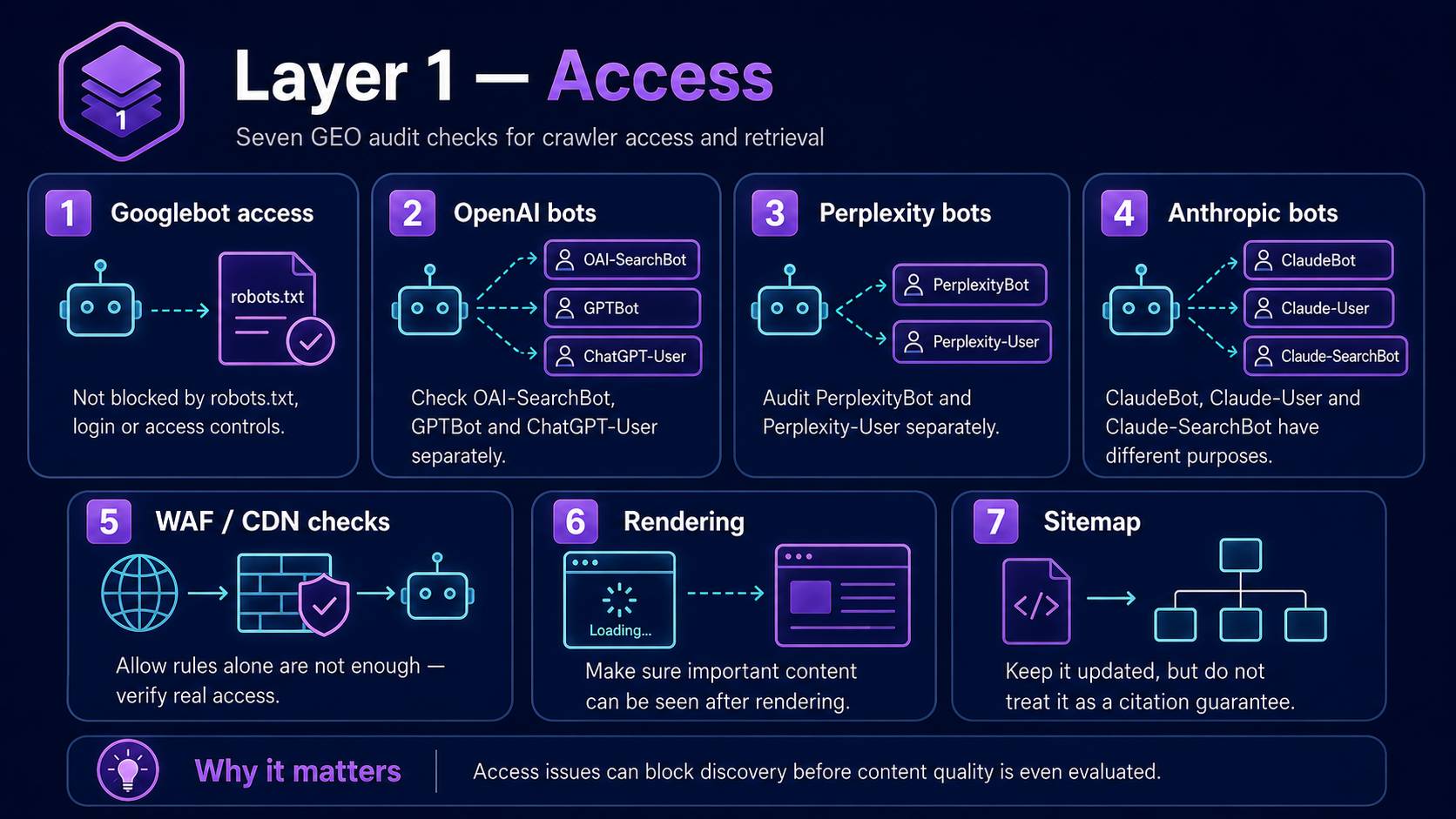
1. Googlebot Can Access the Target Page
First, confirm that Googlebot can access and render the target page normally. Check that it is not blocked by robots.txt, login requirements, firewall rules, or other access controls.
For AI Overviews and AI Mode, Google Search still relies on its standard crawling, indexing, and preview controls. See Google’s guidance on AI features and your website.
One important distinction: Google-Extended is not the control for including or excluding a website from AI Overviews or AI Mode. It is a separate publisher control for certain AI training and grounding uses. Blocking Google-Extended does not prevent a site from appearing in Google Search and is not a Google Search ranking signal.
Audit action: Test the target URL with Google Search Console’s URL Inspection tool and review robots.txt and other access controls to confirm that Googlebot can fetch the page without restriction.
2. Treat OAI-SearchBot, GPTBot and ChatGPT-User Separately
If you want your content to be discoverable in ChatGPT Search, first confirm that OAI-SearchBot has not been blocked unintentionally in robots.txt or at the network layer.
According to OpenAI’s crawler documentation, OAI-SearchBot, GPTBot and ChatGPT-User serve different purposes. OAI-SearchBot is used to surface websites in ChatGPT search results, while GPTBot crawls content that may be used to train OpenAI’s generative AI foundation models. ChatGPT-User is used for certain user-initiated actions in ChatGPT and Custom GPTs and is not used to determine whether content can appear in Search.
Whether to allow GPTBot should therefore be treated as a separate policy decision. Allowing GPTBot is not required for appearing in ChatGPT Search.
Audit action: Review robots.txt, WAF or CDN rules, and OpenAI’s published IP ranges to confirm that OAI-SearchBot is allowed if ChatGPT Search visibility is a goal, while setting a separate policy for GPTBot based on your organisation’s training-data preferences.
3. Do Not Treat PerplexityBot and Perplexity-User as the Same Thing
Perplexity uses two separate user agents for different purposes.
According to Perplexity’s crawler documentation, PerplexityBot is designed to discover, surface, and link websites in Perplexity search results. If Perplexity visibility is a goal, confirm that PerplexityBot is allowed in robots.txt and is not being blocked by WAF, CDN, or server-level rules.
Perplexity-User, by contrast, supports user-initiated actions. When a user asks Perplexity a question, it may fetch a webpage to help answer the request and include a link to that page. Because the fetch is user-requested, Perplexity states that Perplexity-User generally ignores robots.txt rules, although actual access can still be affected by network-level controls.
Audit action: Check PerplexityBot and Perplexity-User separately in robots.txt, WAF/CDN rules, and server logs rather than treating them as a single Perplexity crawler setting.
4. Check Anthropic Bots Separately by Purpose
Anthropic uses different crawlers for different purposes, so they should not be treated as a single Claude access setting.
According to Anthropic’s crawler guidance, ClaudeBot, Claude-User, and Claude-SearchBot serve different functions. ClaudeBot may collect web content for potential model training, Claude-User may access webpages in response to user requests, and Claude-SearchBot supports search-related retrieval.
That means allowing ClaudeBot does not by itself mean that a site is accessible or optimised for Claude Search. Training access, user-initiated fetching, and search retrieval should be evaluated separately.
Audit action: Review robots.txt, WAF/CDN rules, and server logs for ClaudeBot, Claude-User, and Claude-SearchBot individually, then align each setting with your organisation’s goals for model training, user-requested access, and search visibility.
5. Make Sure WAF, CDN and Bot Protection Are Not Blocking Legitimate Crawlers
An Allow rule in robots.txt does not guarantee that a crawler can actually access the page.
A WAF, CDN rule, rate limit, CAPTCHA, JavaScript challenge, or other bot-protection layer may still return a 403, 429, or another response that prevents access.
An audit should therefore go beyond robots.txt and review:
- Server logs
- CDN and WAF logs
- Actual HTTP responses returned to legitimate crawlers
Audit action: Test representative URLs and compare crawler access across robots.txt, network-level controls, and server responses to confirm that legitimate search and AI crawlers are not being blocked unintentionally.
6. Make Sure Important Content Can Render Properly
Do not treat “all important content must be in the initial HTML” as a fixed GEO rule.
Google can process JavaScript, so the more useful audit question is: Can Google access and see the main content after rendering? See Google’s JavaScript SEO guidance.
For other AI crawlers, do not assume they have the same JavaScript rendering capabilities as Google. Check the actual retrieved or rendered output where possible, especially for content that depends heavily on client-side JavaScript.
Also, avoid serving crawlers materially different core content from what normal users see.
Audit action: Test representative JavaScript-dependent pages to confirm that their main content, links, headings, and key information remain accessible after rendering, and verify actual retrieval behaviour for important AI crawlers where possible.
7. Keep the Sitemap Up to Date, but Do Not Treat It as a Citation Guarantee
Important indexable URLs should generally be included in an up-to-date sitemap, particularly on large, new, or frequently updated websites.
According to Google’s sitemap guidance, a sitemap helps search engines discover URLs, but submitting one does not guarantee that a page will be crawled or indexed. It also does not guarantee that a page will be retrieved or cited by an AI system.
For Google Search, there is no requirement to create separate machine-readable AI files, AI text files, special Markdown versions, or an llms.txt file to become eligible for AI Overviews or AI Mode. If your team uses llms.txt or similar files for other tools, experiments, or internal workflows, treat them as an optional extra, not a replacement for a crawlable website, clear internal links, and an accurate sitemap.
Audit action: Confirm that important canonical, indexable URLs are included in the sitemap, remove outdated or non-indexable URLs where appropriate, and check that the sitemap is accessible and current.
Layer 1.5 — Search Eligibility: 2 Checks
Being accessible to a crawler does not automatically mean that a page is eligible to appear as a supporting link in Google AI Overviews or AI Mode.
For Google’s generative AI features in Search, the page still needs to meet the underlying requirements for Google Search, including being indexable and eligible to appear with a search snippet.
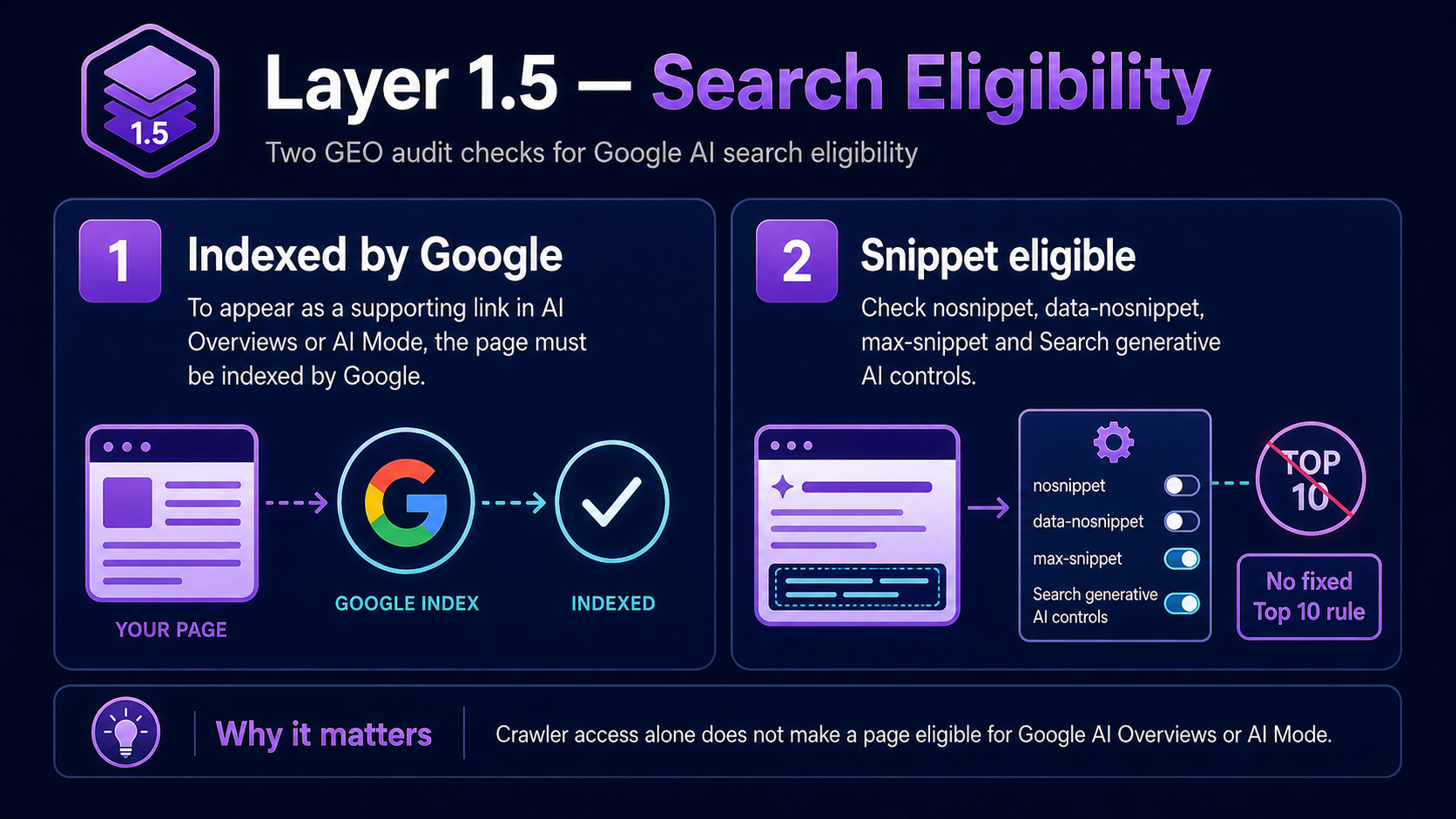
8. The Target Page Is Indexed by Google
To be eligible to appear as a supporting link in AI Overviews or AI Mode, the target page must be indexed by Google.
If the page is not indexed, fix the indexing issue first rather than spending time rewriting passages or applying so-called “AI writing optimisation”. Content refinement cannot compensate for a page that is not available in Google’s index.
Audit action: Use Google Search Console’s URL Inspection tool to confirm whether the target URL is indexed and review any reported indexing issues before moving on to content-level GEO checks.
9. The Target Page Is Eligible to Show a Snippet in Google Search
The page must also be eligible to appear in Google Search with a snippet.
During the audit, check preview controls such as nosnippet, data-nosnippet, and max-snippet. If the page uses noindex, address its indexing eligibility first.
Do not add ranking thresholds that Google has not published, such as:
“A page must rank in the organic Top 10 before it can appear in AI Overviews.”
Google has not published any such fixed ranking requirement. To be eligible as a supporting link in AI Overviews or AI Mode, a page must be indexed and eligible to appear in Google Search with a snippet. See Google’s guidance on AI features and your website.
Google also provides a Search generative AI control in Search Console under Settings > Search generative AI. As of 31 August 2026, this control is available to all websites worldwide.
For most properties, inclusion is the default setting, although a child property may inherit its setting from a parent property. If a property is excluded, its links and content will not appear in the relevant Search generative AI features.
Audit action: Open the target property in Search Console and verify its current Search generative AI setting rather than assuming the default is still active. Also review snippet and indexing controls to confirm that the page remains eligible to appear in Google Search.
A page can be crawlable, indexed, and snippet-eligible without being retrieved or cited for a specific query. If the page has little or no conventional visibility for that query, improving passage structure alone is unlikely to make it a strong AI retrieval candidate.
Think of these as separate stages: accessible ≠ eligible ≠ retrieved ≠ cited.
For a deeper look at what influences the retrieval stage, see how to rank in AI Overviews.
Layer 2 — Entity Clarity: 5 Checks
This layer reviews whether brand, author, and business information is presented clearly and consistently across key pages and structured data.
The goal is to reduce unnecessary ambiguity about the people and organisations represented on the website. These checks are intended to improve entity clarity and should not be treated as GEO ranking factors published by Google or other AI platforms.
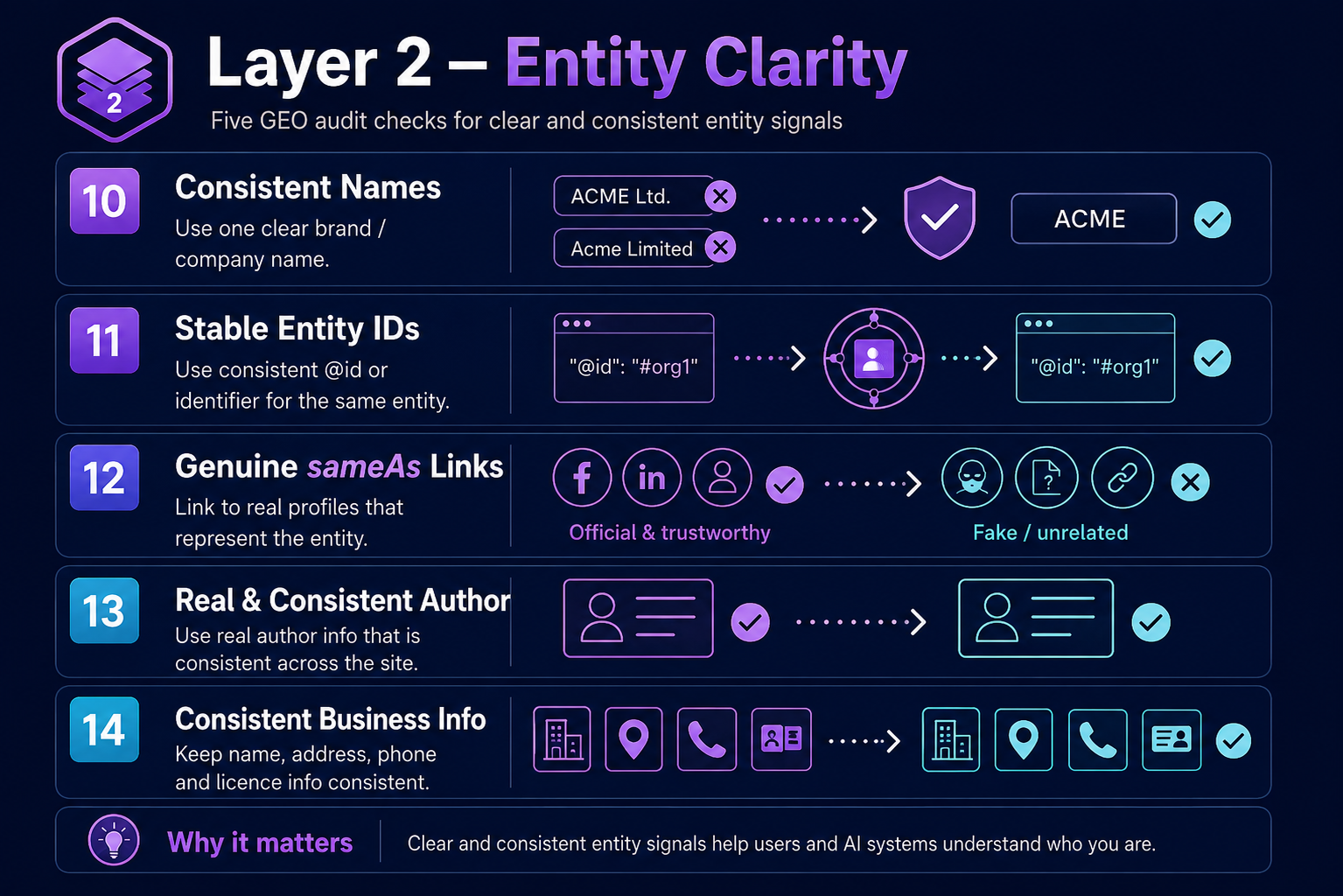
10. Keep Organisation Names Consistent
Use a clear naming convention for the official brand name, shortened brand name, and legal company name across important pages.
Avoid unnecessary variations that could make it unclear whether different names refer to the same organisation. Where different versions are genuinely needed, make their relationship clear.
Audit action: Compare the organisation name across the homepage, About page, contact details, author or publisher information, and structured data, and resolve inconsistent or unexplained variants.
11. Keep Structured Data Entity Identifiers Consistent
If the website uses Organization structured data, keep identifiers for the same entity consistent where appropriate. See Google’s Organization structured data guidance.
For example, if an @id is used to identify the organisation across connected structured data nodes, avoid creating multiple unnecessary identifiers for the same entity.
The purpose is to give the same organisation a clear and stable reference within the structured data, not to create an artificial ranking signal.
Adding or standardising an @id does not guarantee higher rankings or more AI citations.
Audit action: Review Organization markup across key templates and confirm that the same organisation is not represented with conflicting names, URLs, or identifiers.
12. Use sameAs Only for Pages That Genuinely Identify the Entity
Use sameAs only for pages or profiles that clearly represent the same organisation or person.
These may include official social media profiles or other trustworthy pages that unambiguously identify the entity. See Schema.org’s sameAs property.
Do not create fake profiles, add loosely related pages, or use unrelated links simply to manufacture an “entity signal”.
Audit action: Review sameAs values in structured data and confirm that each URL genuinely refers to the same entity and remains live, accurate, and relevant.
13. Keep Author Information Real and Consistent
If an article lists an author, make sure the author name, job title, profile page, and biography are genuine and consistent across the website.
Where Person or Article structured data is used, the visible author information should also match the structured data. See Google’s Article structured data guidance.
Do not create fake experts, inflated credentials, or fictional author identities simply to make content appear more authoritative.
Audit action: Compare visible author bylines, author profile pages, biographies, and structured data across representative articles, and resolve conflicting names, titles, or identities.
14. Keep Business and Contact Information Consistent
If the company name, address, phone number, or other contact details appear across multiple pages, keep them accurate and consistent.
Where relevant, compare these details with the organisation information used in structured data and other official business profiles.
If the industry requires licence, registration, or regulatory information to be displayed, confirm that those details are also current and consistent. However, registration details are not a universal GEO requirement for every website.
Audit action: Review key business details across the homepage, About page, Contact page, footer, structured data, and other important profiles, and correct unexplained inconsistencies.
Layer 3 — Content Clarity: 8 Checks
This layer checks whether the content is clear, easy to navigate, and able to answer important questions efficiently.
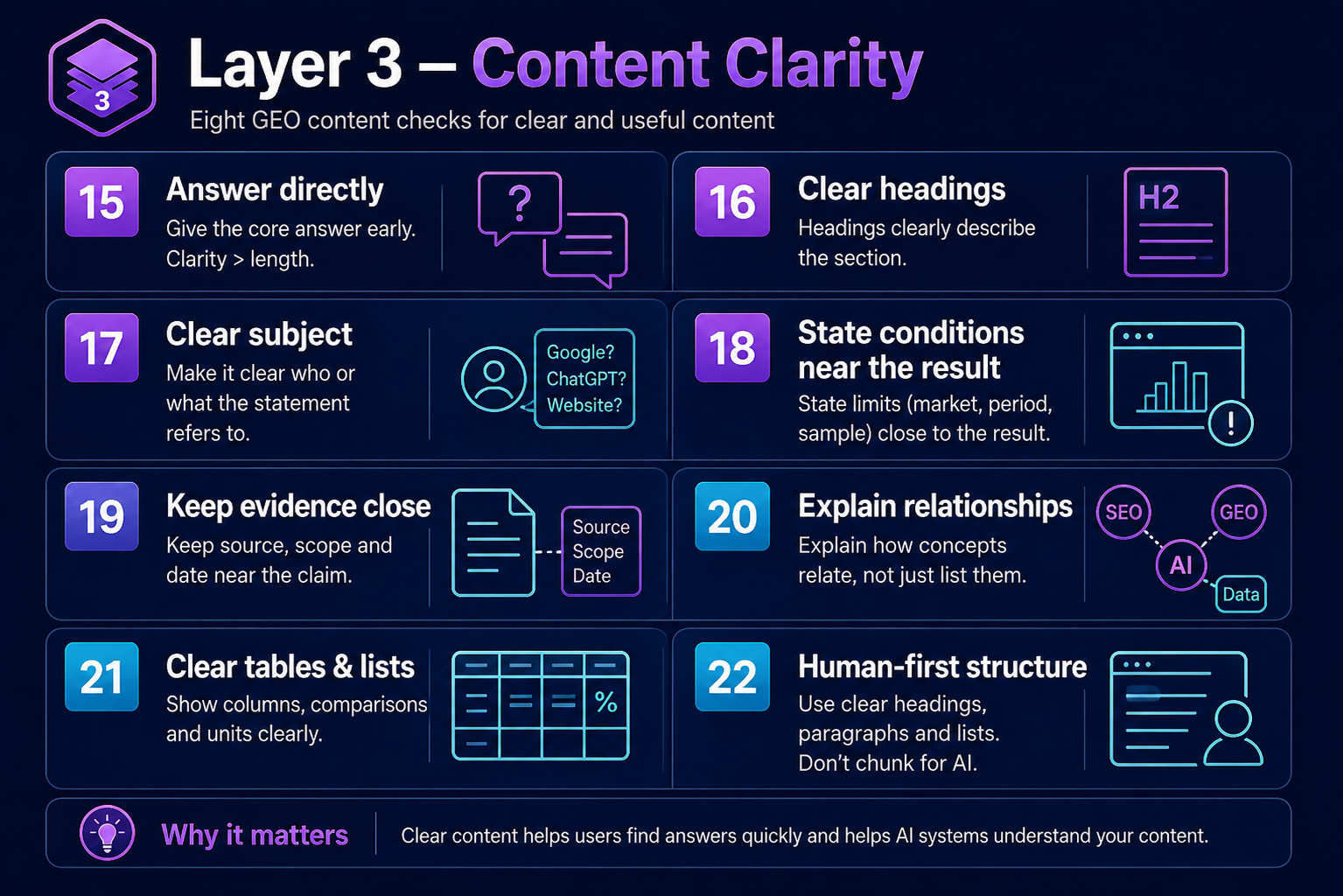
15. Answer Important Questions Directly
If a section answers a specific question, give the core answer early instead of making readers work through several paragraphs of background first.
There is no fixed answer length. The answer should be long enough to be accurate and useful, but short enough that the main point is easy to find.
Audit action: Review important question-based sections and check whether the main answer appears early, clearly addresses the query, and avoids unnecessary setup before the useful information.
16. Headings Should Clearly Describe the Section
Headings should make it clear what information the reader will find in each section.
A question heading can work well when it reflects how people genuinely search or when the section answers a specific question. However, not every H2 needs to be written as a question.
The goal is a clear information hierarchy that helps readers scan the page and find relevant answers quickly.
Audit action: Review H2 and H3 headings and replace vague, generic, or overly clever wording with headings that accurately describe the content that follows.
17. Important Statements Should Have a Clear Subject
Important statements should make it clear who or what they refer to.
Avoid repeatedly using vague terms such as:
- “it”
- “this”
- “this area”
- “these systems”
when the intended subject could be unclear.
For example, make it explicit whether a statement refers to Google Search, ChatGPT Search, Perplexity, the website being audited, or a specific research result.
Audit action: Review important factual and technical statements and replace unclear pronouns or generic references with explicit subjects where needed.
18. State Important Conditions Close to the Result
If a result applies only to a specific market, period, sample, or methodology, state those conditions close to the result itself.
For example, our Hong Kong AI Overview triggering study tracked 60 commercial and service-related keywords in Hong Kong from 1 June to 10 August 2026. AI Overviews appeared for 41 of the 60 tracked keywords, equivalent to between 68% and 75% depending on whether five keywords without a usable SERP record are included in the denominator.
This was a focused test sample and should not be treated as representative of all Hong Kong searches.
Audit action: Check every important statistic or research finding and keep its sample, market, test period, methodology, and limitations close to the result.
19. Keep Supporting Evidence Close to Important Statements
If the content includes numbers, research findings, platform policies, or technical requirements, place the relevant source and scope near the statement it supports.
This helps readers quickly understand:
- Where the information came from
- What the evidence applies to
- Whether it is still current
For platform-specific claims, link to the relevant official documentation where available. For first-party research, link directly to the underlying study or methodology page.
Do not place important evidence several sections away from the claim it is meant to support.
Audit action: Review factual and technical claims and confirm that each important statement has nearby evidence, source context, or methodology where appropriate.
20. Explain How Different Concepts Relate to Each Other
Do not simply add related terms such as:
- SEO
- GEO
- structured data
- AI Overviews
What matters more is explaining how those concepts relate to each other.
For example:
- How does structured data support search understanding without acting as a guaranteed AI citation signal?
- Where do SEO and GEO overlap, and where do they differ?
- How do indexing, retrieval, and citation fit into the same search journey?
Explaining these relationships is more useful than simply adding more related terminology.
For a broader comparison, see how GEO and SEO overlap and differ.
Audit action: Review sections that introduce related concepts and check whether the relationships between them are explained clearly rather than presented as isolated terms.
21. Tables and Lists Should Have Clear Labels
Tables and lists should be easy to understand without requiring readers to decode the structure first.
Clearly show:
- What each column represents
- What is being compared
- Which units or time periods are being used
- What any abbreviations or categories mean where they may be unclear
Readers should be able to understand the purpose of a table or list at a glance.
Audit action: Review important tables and lists and confirm that headings, labels, units, comparison criteria, and supporting notes are clear enough to interpret the information correctly.
22. Do Not Break Content Into Too Many Small Sections Just for AI Search
Google does not require websites to split content into many small chunks so that its generative AI systems can understand it, and Google does not specify an ideal page length. See Google’s guide to optimising for generative AI features in Search.
Do not divide an article into many one- or two-sentence sections purely for supposed “AI readability”. Shorter or longer sections can both work depending on the topic and the reader’s needs.
Structure content for human readers first, using clear headings, paragraphs, tables, and lists where they genuinely improve understanding and navigation.
Audit action: Review the page structure and merge unnecessarily fragmented sections where doing so improves flow, while keeping headings and formatting that genuinely help readers find information quickly.
Layer 4 — Evidence: 4 Checks
This layer checks whether important claims are supported by enough evidence and whether data, scope, and conclusions are explained clearly.
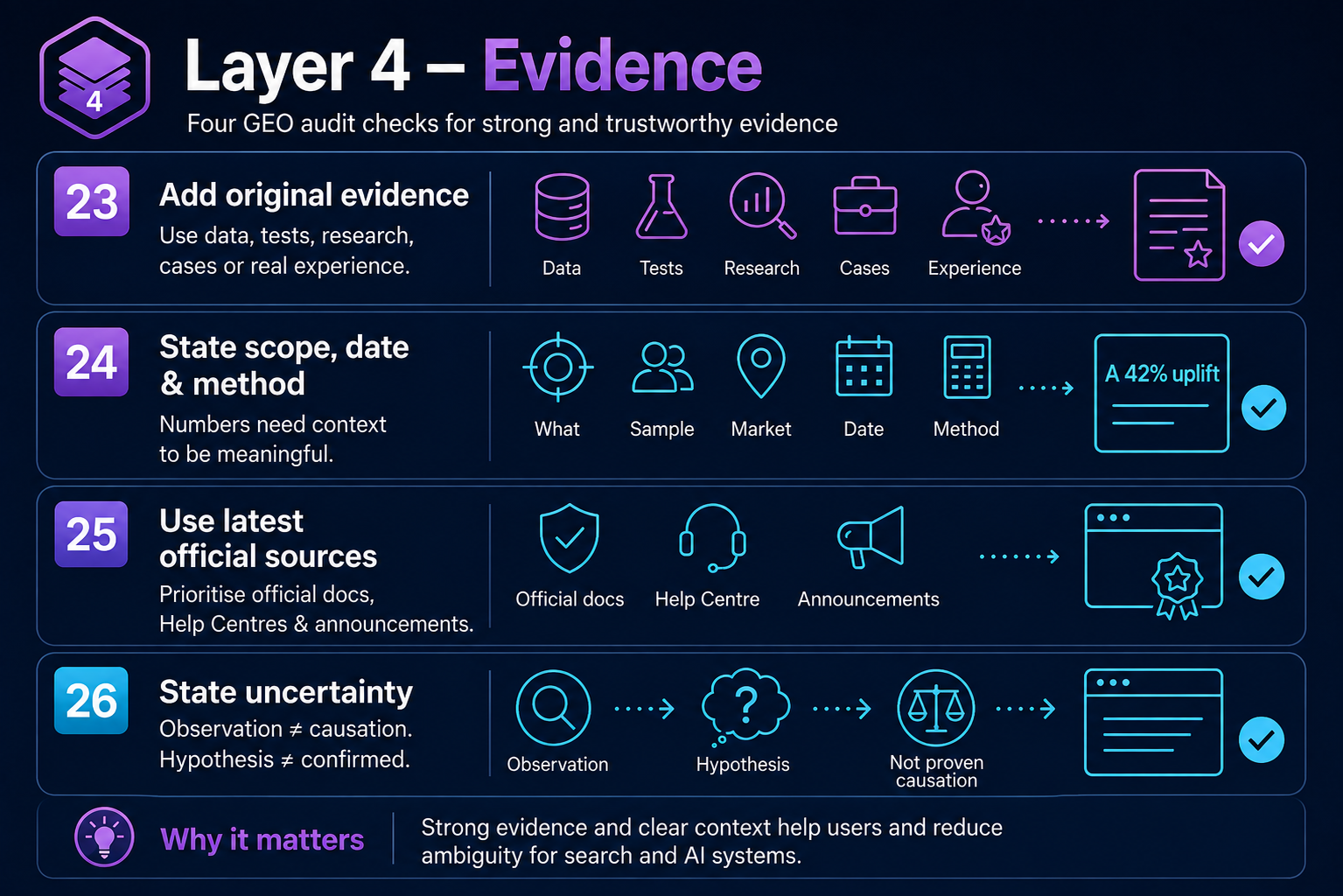
23. Add Original Evidence to Important Topic Clusters Where Possible
Where relevant, strengthen important topic clusters with original evidence such as:
- First-party data
- Practical tests
- Original research
- Real case studies
- Professional or first-hand experience
Original evidence can add value beyond simply summarising information already available elsewhere and may give readers a clearer reason to trust, cite, or return to the content.
Google’s 2026 guidance for generative AI features in Search also emphasises valuable, unique and non-commodity content, including original perspectives and first-hand experience rather than simply recycling information already available online.
Audit action: Identify commercially or strategically important topic clusters and check whether first-party data, testing, case studies, or expert experience could add meaningful evidence rather than creating research purely for the sake of GEO.
24. State the Scope, Date and Method for Important Numbers
Do not present a number without enough context to interpret it.
For example, a statement such as:
“A 42% uplift”
is difficult to evaluate unless readers can also see the sample size, market, test period, methodology, comparison basis, and denominator.
For a real example, Maxlytics tracked 60 commercial and service-related keywords in Hong Kong from 1 June to 10 August 2026. AI Overviews appeared for 41 of the 60 tracked keywords, equivalent to between 68% and 75% depending on whether five keywords without a usable SERP record are included in the denominator.
This was a focused test sample and should not be treated as representative of all Hong Kong searches.
Audit action: Review important statistics and make sure the sample, scope, market, date range, calculation method, denominator, and relevant limitations are stated close to the result.
25. Use the Latest Official Sources for Platform Information That Can Change
Crawler names, Search Console features, AI Search settings, and platform policies can change over time.
For this type of information, prioritise:
- Official documentation
- Official Help Centres
- Official product or platform announcements
Third-party articles can still be useful for context or interpretation, but they should not replace the latest official source when the claim concerns a platform feature, crawler purpose, eligibility rule, or technical setting.
Audit action: Review time-sensitive platform claims and confirm that each one is supported by a current official source, especially for crawler names, bot purposes, Search Console controls, AI Search features, and platform policies.
26. State Uncertainty Clearly
Do not present an observation as proven causation.
If a finding is based on a limited test, correlation, or working hypothesis, describe it that way rather than presenting it as a platform-confirmed mechanism.
Two things happening at the same time does not necessarily mean that one caused the other.
Where uncertainty exists, make the distinction clear between:
- What was observed
- What is inferred
- What remains unconfirmed
- What the platform has officially documented
Audit action: Review causal claims and replace overly certain language where the evidence only supports an observation, correlation, hypothesis, or limited test result.
Layer 5 — Structured Data Consistency: 4 Checks
This layer checks whether structured data is accurate, relevant to the page, consistent with visible content, and not given more importance than it deserves.
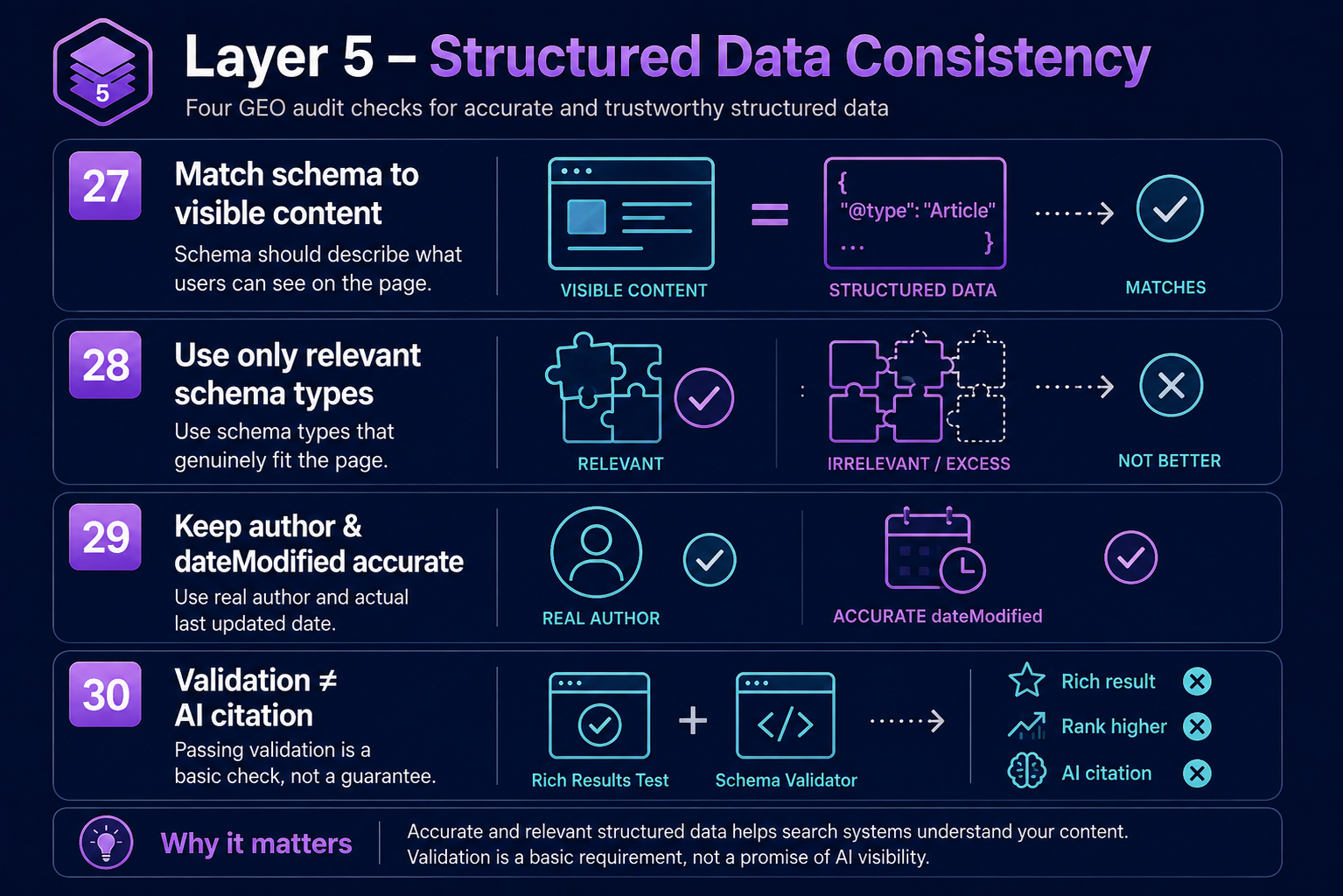
27. Structured Data Should Match the Visible Page Content
Structured data should accurately describe what users can actually see on the page.
Do not add information that is absent from the visible content, unrelated to the page, or potentially misleading. Google’s structured data policies require markup to accurately represent the content it describes. See Google’s structured data guidelines.
The key principle is simple: claims made in structured data should be supported by the visible page content.
Audit action: Compare important structured data properties with the visible page and remove or correct information that is unsupported, outdated, misleading, or inconsistent.
28. Use Only Structured Data Types That Fit the Page
Do not add large amounts of schema simply because you want to improve GEO.
First ask: Does this structured data type genuinely match the content and purpose of this page?
Structured data can help search systems understand page information and can support eligible Search features, but adding more markup does not automatically create more visibility.
More schema ≠ more AI visibility.
Google’s 2026 guidance also states that structured data is not required for generative AI features in Search and that websites do not need special schema.org markup specifically for those features.
Audit action: Review the structured data types used on representative pages and remove irrelevant or unsupported markup rather than adding schema solely for supposed GEO benefits.
29. Author and dateModified Should Reflect Reality
If an article includes author information, use a real author or editorial team rather than creating a fictional expert identity to make the content appear more authoritative.
The dateModified value should reflect when the article was meaningfully updated. Do not automatically refresh it every day, every crawl, or on a fixed schedule simply to make the content appear newer.
A visible review date or internal “next review due” date can be useful for editorial maintenance, but it should not be treated as a content modification date unless the page has actually been updated.
Audit action: Compare the visible author and review information with the page’s structured data and confirm that dateModified reflects a genuine content update.
30. Passing Schema Validation Does Not Guarantee a Citation
Passing the Rich Results Test or Schema Markup Validator only shows that the markup passes the checks performed by that tool.
It does not guarantee that the page will:
- Receive a rich result
- Rank higher
- Be retrieved by an AI system
- Receive an AI citation
Google also does not require special structured data or a dedicated schema type for generative AI features in Search.
Schema validation is a basic technical check, not a guarantee of AI visibility or citation.
Audit action: Validate representative pages for syntax and eligibility issues, then evaluate structured data alongside the visible content, indexing status, search visibility, and other page-level signals rather than treating a successful validation result as an outcome.
Layer 6 — Link Architecture: 3 Checks
This layer checks whether internal links clearly show how related pages connect within the same topic cluster and whether important pages have distinct roles.
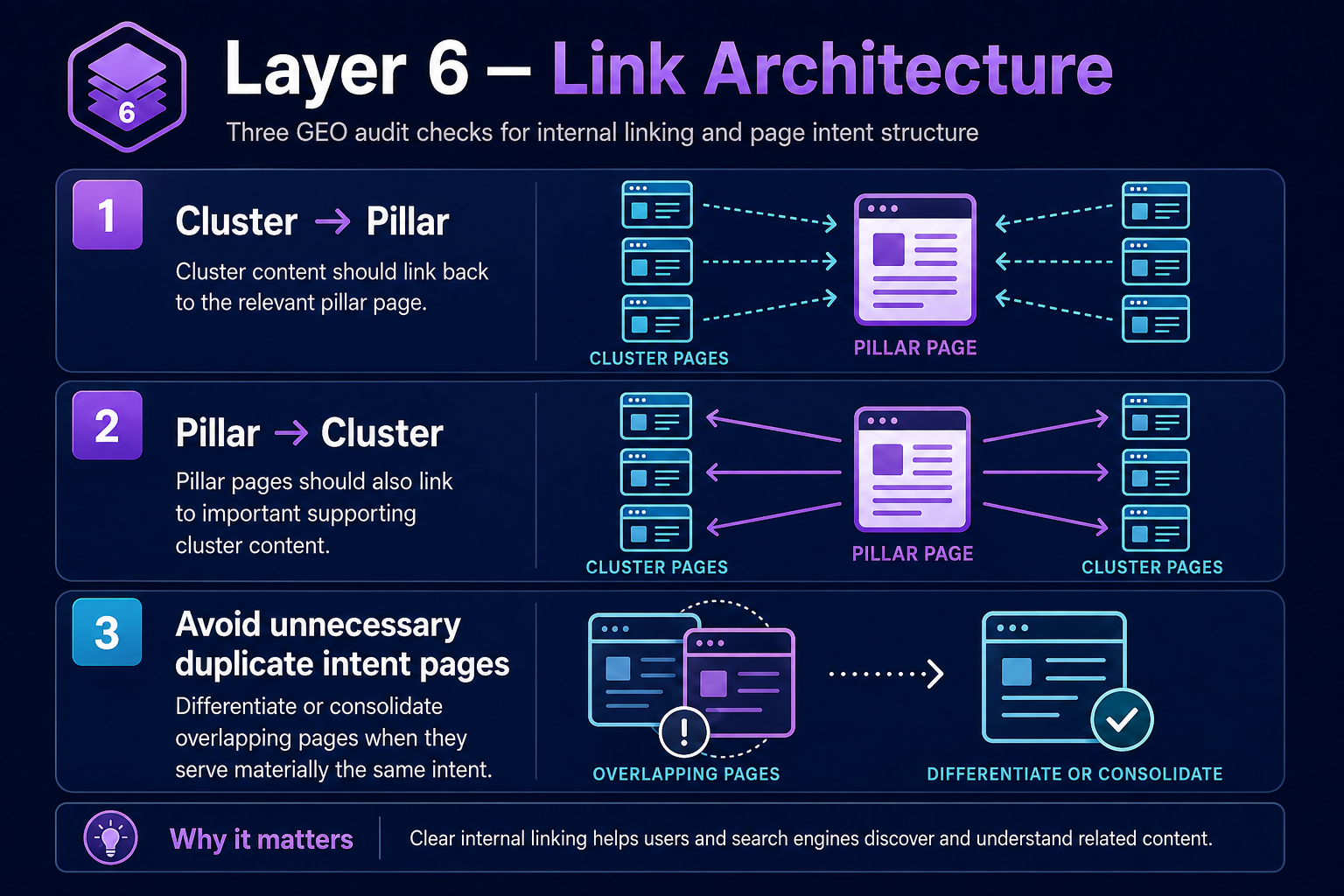
31. Cluster Content Should Link Back to the Relevant Pillar
If an article belongs to a topic cluster, link to the most relevant pillar, hub, or service page where doing so helps readers understand the wider topic or take the next step.
For example, an article about Generative Engine Optimization can link to our Generative Engine Optimization team in Hong Kong when the reader needs broader GEO services, auditing, or implementation support.
Internal links should be contextual and descriptive, rather than added only to increase link counts.
Audit action: Review important cluster articles and confirm that each one links to the most relevant pillar or service page using descriptive anchor text where appropriate.
32. Pillar Pages Should Also Link to Important Cluster Content
Do not rely only on one-way internal linking patterns such as:
Blog → Service
If a cluster article provides useful depth on a topic introduced by a pillar page, the pillar should also link back to that article where relevant.
Internal links should reflect real topic relationships and useful reader journeys, rather than only directing visitors from informational content toward commercial pages.
Audit action: Review important pillar and service pages and identify cluster articles that add meaningful supporting detail, then add reciprocal links where they improve navigation and topic structure.
33. Avoid Unnecessary Duplicate or Near-Duplicate Intent Pages
If several pages answer materially the same question for the same audience, decide whether they should be consolidated, differentiated more clearly, or given more distinct roles.
This does not mean that every search intent can have only one URL. Multiple pages can be useful when they serve different subtopics, stages, audiences, or use cases.
The goal is to avoid unnecessary duplication and make the purpose of each important page clear within the site architecture.
Where one page is the primary resource for a topic, related pages can cover narrower questions, specific use cases, supporting evidence, or adjacent angles and link back to the primary page where relevant.
Audit action: Review pages with overlapping topics and compare their target query, audience, search intent, and purpose before deciding whether to consolidate, differentiate, or strengthen the internal linking between them.
Layer 7 — Bilingual Layer: 2 Checks
This layer checks whether canonical and hreflang signals are aligned across English and Traditional Chinese pages, which is especially relevant for multilingual markets such as Hong Kong.
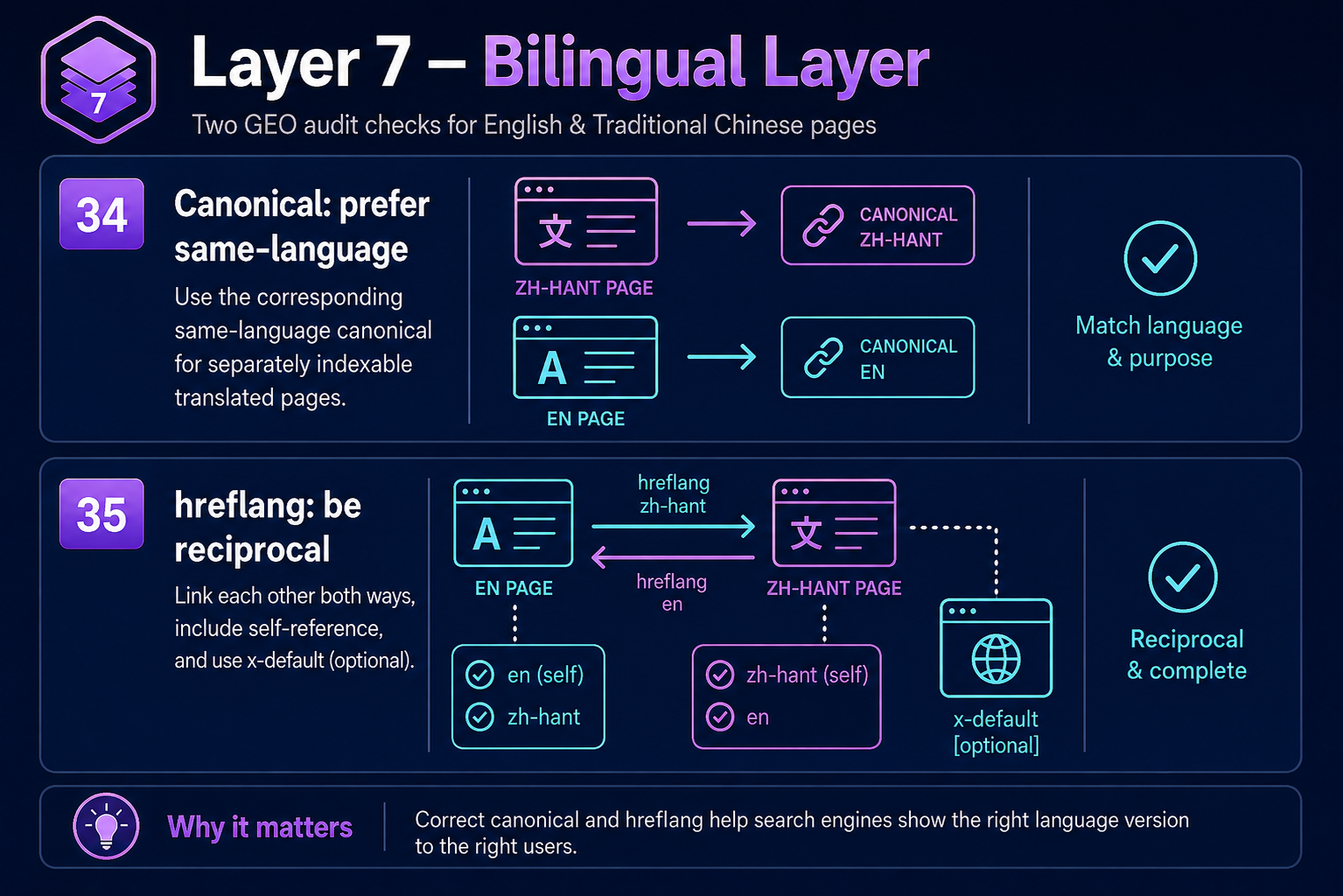
34. Canonical Should Usually Point to the Intended Same-Language Page
For fully translated language versions that are intended to be indexed separately, the canonical should usually point to the corresponding same-language URL, rather than consolidating the translated page into another language version.
For example:
- Traditional Chinese page → Traditional Chinese canonical
- English page → English canonical
A complete Traditional Chinese page that is intended to appear independently in Search should therefore generally not canonicalise directly to the English version.
See Google’s canonicalisation guidance.
However, canonicalisation depends on whether pages are genuinely duplicate or near-duplicate versions. The key question is whether the canonical setup matches the page’s language, content, and intended indexing role.
Audit action: Review English and Traditional Chinese URL pairs and confirm that independently indexable translated pages are not being unintentionally consolidated into another language version.
35. hreflang Should Be Reciprocal
When hreflang is used, each language version should reference itself and the relevant alternate versions, and the links should be reciprocal.
According to Google’s guidance on localized versions, if an English page points to a Traditional Chinese version with hreflang, the Traditional Chinese page should also point back to the English page.
For example:
- English page → English + Traditional Chinese
- Traditional Chinese page → Traditional Chinese + English
If the return link is missing, Google may ignore or fail to interpret the affected hreflang annotations correctly.
An x-default URL can also be added as a fallback when no specific language or regional version is the best match, such as a language selector or default landing page. It is optional rather than required for every hreflang implementation.
Audit action: Check representative bilingual URL pairs for reciprocal links, self-referencing entries, valid language codes, fully qualified URLs, and an appropriate x-default where a genuine fallback page exists.
Layer 8 — Measurement: 2 Checks
This layer checks whether AI visibility can be measured consistently and repeatedly, so that changes in the testing method are not mistaken for real performance changes.
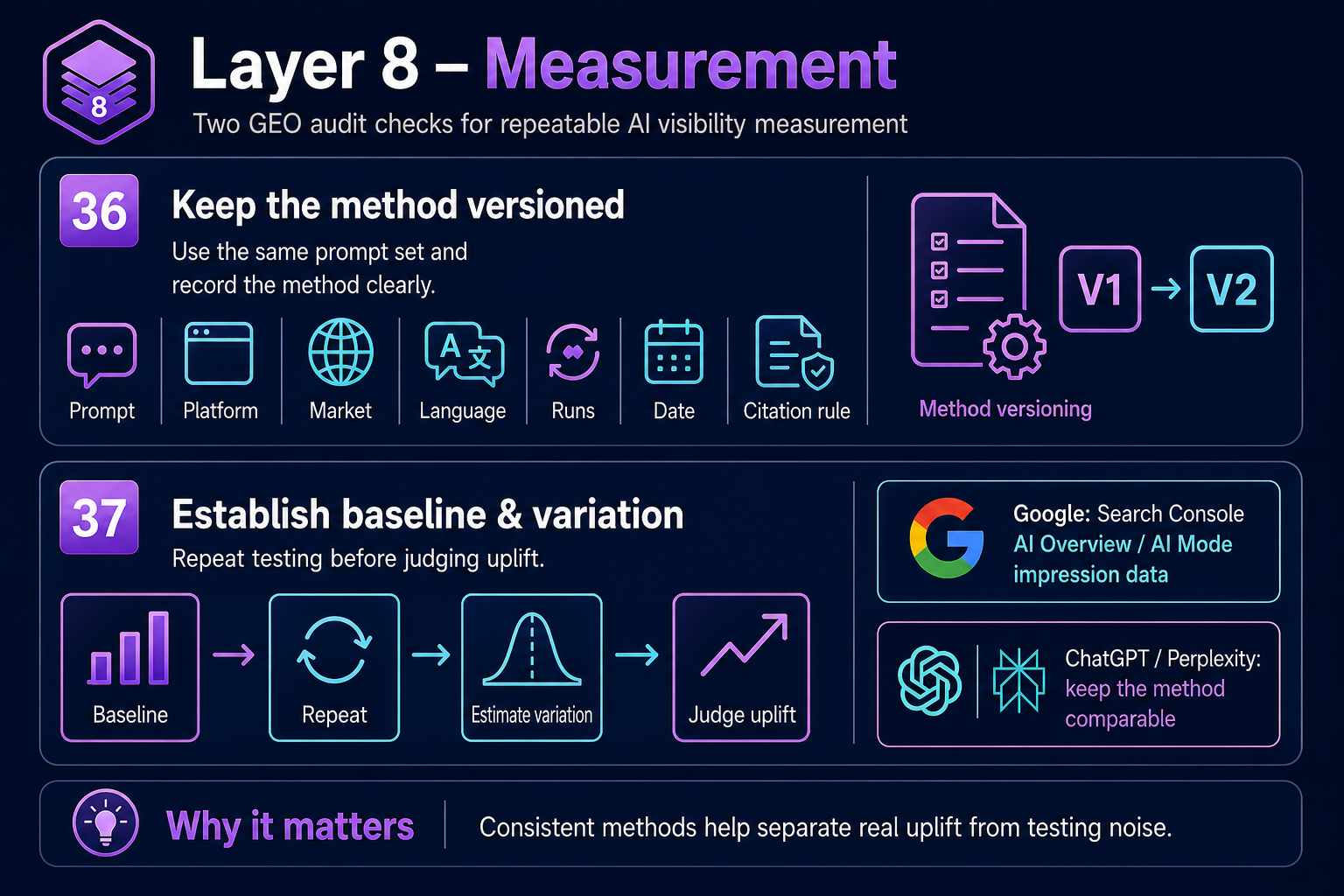
36. Keep the Prompt Set and Measurement Protocol Consistent and Versioned
Before establishing a baseline, document the testing method, including:
- Prompt
- AI platform or search surface
- Market or location
- Language
- Run count
- Testing date
- Citation definition
- Exclusion rules
If the prompt set or methodology changes later, record the new version rather than silently replacing the original protocol.
Do not change the testing conditions and then compare the old and new results as though the methodology were identical.
For a broader framework, see how to measure AI search visibility.
Audit action: Create a versioned measurement protocol and keep the core testing conditions stable enough that changes in visibility can be compared meaningfully over time.
37. Establish a Baseline and Normal Variation Before Major Optimisation
Before major optimisation begins, establish a baseline for the site’s current AI visibility.
Then repeat the test using the same method, or one that is reasonably comparable, to estimate how much the result varies under normal conditions.
Otherwise, a small rise or fall may simply reflect testing variation rather than a meaningful change caused by optimisation.
A practical sequence is:
Establish baseline → Repeat testing → Estimate normal variation → Judge whether the uplift is meaningful
For Google, use the Generative AI performance report in Search Console alongside your own testing where available. Google launched dedicated Generative AI performance reports on 3 June 2026 and, as of 31 August 2026, has rolled these insights out to all websites worldwide.
The Search report currently shows impression data from supported generative AI features, including AI Overviews and AI Mode, and can be analysed by Pages, Countries, Devices, and Dates.
Treat this as an exposure signal rather than a traffic measure. The report currently shows impressions rather than clicks, so it can help you understand where your site is appearing in Google’s generative AI search experiences, but it does not show how much traffic those appearances generate.
For other platforms such as ChatGPT and Perplexity, continue using a documented prompt-based testing method so that future tests remain reasonably comparable.
Audit action: Establish a baseline before major changes, repeat the same test enough times to understand normal variation, and use Search Console impression data together with prompt-based testing rather than treating either source as a complete measure of AI visibility.
How Should These 37 Checks Be Carried Out?
The 37 checks are arranged mainly by dependency, but in practice you do not need to complete every item in one layer before moving to the next.
A practical approach is to establish the measurement baseline while reviewing access and technical issues in parallel. Once search eligibility is confirmed, move on to entity clarity, content clarity, evidence, structured data, link architecture, and bilingual implementation.
After the main issues have been addressed, repeat the measurement using the same method, or one that is reasonably comparable, so that changes can be evaluated against the original baseline.
The workflow can be simplified as:
Measure → Find problems → Fix → Improve → Measure again
The first measurement establishes the baseline. The audit identifies technical, content, and structural issues. The second measurement helps determine whether the changes produced a meaningful improvement beyond normal variation.
The goal is not to complete Check 1 to Check 37 once and then stop. Build a repeatable GEO audit process that allows visibility before and after optimisation to be compared consistently over time.

How Are These 37 Checks Ordered?
The 37 checks are arranged mainly by dependency, not by expected impact.
There is currently no validated public framework that can reliably compare the exact contribution of individual checks to AI citations across different websites and search environments. For example, we cannot credibly say that Check 18 has a greater citation impact than Check 24 in every case.
There is also no reliable universal weighting system that applies consistently across different brands, AI platforms, markets, languages, query sets, and testing methods.
This checklist should therefore not be treated as a GEO ranking score.
Completing all 37 checks also does not guarantee an AI citation. Their purpose is to provide a structured way to review access, search eligibility, entity clarity, content clarity, evidence, structured data, link architecture, bilingual SEO, and measurement.
This is a GEO audit framework, not a validated ranking formula.

FAQ
Q1: Where Should Generative Engine Optimization Start?
Start with access, Google Search eligibility, and a measurement baseline. If important crawlers cannot access the page properly, or if the target page is not indexed or eligible to appear with a Search snippet, address those foundation issues before spending time on content-level optimisation. At the same time, establish a baseline before major changes so that later shifts in AI visibility can be compared using a consistent method.
Q2: Will Blocking Google-Extended Remove a Website From AI Overviews?
No. Google-Extended does not control whether a website can appear in AI Overviews or AI Mode, does not affect inclusion in Google Search, and is not used as a Google Search ranking signal. Google provides a separate Search generative AI control in Search Console for managing whether a site's links and content can appear in supported Search generative AI features, while Googlebot and standard Search controls still apply to crawling, indexing, and previews; for example, noindex can prevent indexing, while nosnippet, data-nosnippet, and max-snippet can affect how content is shown in Search.
Q3: If All 37 Checks Are Complete but There Is Still No AI Citation, Does That Mean Something Is Missing?
Not necessarily. These checks cover access, search eligibility, entity clarity, content clarity, evidence, structured data, link architecture, bilingual SEO, and measurement, but completing them does not guarantee that a page will be retrieved or cited by an AI system. For Google specifically, meeting the technical requirements and best practices for AI features in Search does not guarantee that a page will be crawled, indexed, served, or selected as a supporting link, so the checklist should be treated as a framework for removing avoidable problems rather than a guaranteed citation formula.
Q4: If Time Is Limited, Which Checks Can Be Skipped?
Priorities can be adjusted based on the website's goals, technical setup, target markets, and relevant AI platforms. For example, a crawler audit for a platform that is not important to the business can be given lower priority, and unnecessary structured data does not need to be added simply for GEO; however, access, search eligibility, content accuracy, and the measurement baseline should remain foundation priorities and should not be replaced by so-called “AI writing tricks” or unsupported optimisation shortcuts.
Running This GEO Checklist on Your Own Site
If you want to go beyond a checklist and assess how your website performs across crawler access, search eligibility, retrieval, citation, and measurement, our Generative Engine Optimization team in Hong Kong can help you establish an AI visibility baseline, identify technical and content gaps, prioritise improvements, and measure the results after implementation.