

Hong Kong AI Overview Study: We Tested 60 Keywords
Google's AI Overviews are common enough in Hong Kong results that ranking first and being read are no longer the same thing. Out of 60 Hong Kong keywords we tested with SERP snapshots dated 1 June to 10 August 2026, 41 returned one — 68.3% of all 60 tested, or 74.5% of the 55 with a usable SERP record. We report both figures because five keywords came back with no usable record, and we would rather show the range than pick the flattering end. We measured each keyword once, so nothing here says the rate is rising — only how high it already was in this sample.
Throughout this page, AI Overview, AIO, Google's AI-generated answer and AI summary all refer to the same feature. What follows, in order: how we tested, the headline range and why it is a range, why marketing keywords lag the categories we serve, why a local pack does not tell you whether you are exposed, what the missing data says about an unclaimed category, and the seven limits you should read before quoting any of it.
Google's AI Overviews are common enough in Hong Kong results that ranking first and being read are no longer the same thing. Out of 60 Hong Kong keywords we tested with SERP snapshots dated 1 June to 10 August 2026, 41 returned one — 68.3% of all 60 tested, or 74.5% of the 55 with a usable SERP record. We report both bounds because five keywords came back with no usable record, and we would rather show the range than pick the flattering end. We measured each keyword once, so nothing here says the rate is rising — only how high it already was in this sample.
Digital marketing keywords actually triggered AI Overviews less often than other industries: 62.5% compared to 79.5% for cross-industry commercial queries. All five insurance keywords we tested triggered one — five of five, which is a pointer, not a sector rate. If you work in marketing but serve clients in other sectors, those clients may already be more exposed to AI Overviews than you are.
Chinese-language keywords triggered more often too — 29 of 36 (80.6%) against 12 of 19 (63.2%) for English — but our Chinese and English keywords differ by topic as well as language, so treat that gap as unexplained rather than as a language effect. A local pack does not shield you either: 12 of the 17 keywords showing a local pack showed an AI Overview alongside it. The variable is the job the searcher is doing — hunting for a specific provider behaves differently from working out what a category involves.
None of this settles whether 68% or 75% is the "true" figure, and that's not really the point. Averages hide how much industries differ from one another. The only way to know your own exposure is to check your own keywords.
Method

We ran this because we could not find published Hong Kong-specific AI Overview triggering data anywhere. The figures in circulation — 20.5% of SERPs, 7.9% of local searches — come from Ahrefs' analysis of 146 million desktop SERPs in September 2025, which reports no Hong Kong cut and no country breakdown at all. We were tired of quoting numbers to Hong Kong clients as if they described this market. Sixty keywords is not a market either, but it is Hong Kong.
This is an original study based on our analysis of 60 Hong Kong search queries using Ahrefs Keywords Explorer. Our keyword selection followed a two-layer structure.
The first layer consisted of 20 AI search and digital marketing queries. These keywords were selected because they reflect the language used by SEO professionals, marketers, agencies, and businesses actively discussing AI search.
The second layer added 40 commercial keywords spanning eight industries. These queries were included to determine whether AI Overviews behave differently outside the marketing sector.
How we defined an AI Overview trigger
We did not eyeball 60 search results pages. For each keyword we read the serp_features field returned by Ahrefs Keywords Explorer with country=hk, and counted the keyword as triggering when that field contained ai_overview.
Three classifications, applied mechanically:
- Triggered — serp_features contains ai_overview.
- Not triggered — the SERP had been checked (serp_last_update present, intent and feature fields populated) but ai_overview was absent.
- No data — serp_last_update was null, or both the intent and feature fields came back empty. An empty field is missing data, not evidence of absence, which is why these five keywords get their own denominator rather than being scored as non-triggers.
This is a third-party snapshot, not a live manual check, and that is a deliberate trade-off: 60 manual incognito checks would be more accurate and would not be reproducible by anyone reading this.
Snapshot timing and data collection
The SERP snapshots used in this study cover the period from June 1 to August 10, 2026, based on the serp_last_update data recorded by Ahrefs. The study was documented on August 11, 2026.
The keywords were not all captured on the same day, so the study does not represent a single-day SERP snapshot. Because AI Overviews can appear, disappear, or change over time, these results should be treated as a snapshot of the Hong Kong search landscape during this period, rather than a permanent measurement.
Why were five keywords excluded from one denominator?
Five keywords didn't return enough data for us to work with. But a missing result doesn't mean an AI Overview wasn't actually there — it just means we couldn't confirm it either way. So we excluded these five from one of our two calculations, rather than assume something the data couldn't support.
The raw keyword list is available on request.
Result 1: between 68% and 75% of tested queries returned an AI Overview

AI Overviews already appear in a substantial portion of Hong Kong searches. We report the trigger rate as a range based on how missing data is calculated:
| Count | |
| Keywords tested | 60 |
| AI Overview present | 41 |
| No AI Overview | 14 |
| No usable SERP record | 5 |
| Rate — excluding no-data (denominator 55) | 74.5% |
| Rate — counting no-data as not triggered (denominator 60) | 68.3% |
Why do we report a range?
Promoting only the higher figure (74.5%) creates a dramatic headline but hides a key research limitation. Presenting both numbers offers decision-makers a transparent, realistic view of current search visibility.
One note on which denominator we use where. Every sub-analysis below runs on the 55-keyword denominator, not the 60-keyword one. The five keywords with no usable record are not spread evenly across our groups — four of the five sit in the same place, the emerging AI-search terms in Result 4 — so forcing them into a subgroup as non-triggers would distort that subgroup far more than it distorts the total. If you want the conservative reading of any subgroup, divide the trigger count by the tested count instead: 10 of 20 for marketing terms, 31 of 40 for cross-industry terms, 12 of 23 for English, 29 of 37 for Chinese.
Neither figure is a statistical bound. 68.3% is what you get by scoring all five missing keywords as non-triggers; 74.5% is what you get by excluding them and assuming they behave like the 55 we could read. The arithmetic ceiling — all five triggering — would be 46 of 60, or 76.7%. We use 68.3% and 74.5% because they are the two defensible treatments of missing data, not because they bracket the truth.
Either way — 41 of 60, or 41 of 55 — an AI Overview sat above the organic results on most of the Hong Kong queries we tested.
Result 2: your clients' categories are further along than ours

This one surprised us: the digital marketing category was not the most exposed to AI Overviews. The categories our clients sell into were.
| Keyword Layer | Tested | No usable data | Denominator | Triggered | Rate |
| Marketing / AI-search terms (English) | 20 | 4 | 16 | 10 | 62.5% |
| Cross-industry Hong Kong commercial terms | 40 | 1 | 39 | 31 | 79.5% |
Marketing and AI-search terms returned an AI Overview in 10 of the 16 keywords we could verify — 62.5%. Cross-industry commercial terms returned one in 31 of 39 — 79.5%. Both rates treat missing data the same way: the five keywords with no usable SERP record are removed from the denominator rather than counted as non-triggers. On the conservative reading the two layers are 10 of 20 and 31 of 40, and the gap holds either way.
All five insurance keywords we tested returned an AI Overview: 旅遊保險, 危疾保險, 人壽保險, 醫療保險 and 汽車保險. Five of five is not a sector rate and we are not going to present it as one — but it is five of five in the sector with the highest commercial stakes in this sample.
Property ran the other way. 按揭計算機 (25,000 searches a month) and 物業估價 (11,000) returned no SERP features at all, which lines up with Ahrefs' global finding that Real Estate is one of the lowest-triggering categories at 5.8%.
That spread — five of five in insurance, nothing at all on the two highest-volume property terms — is wider than the spread in our headline number. The average is the least useful figure on this page.
Observation (not a result): Chinese queries triggered more often than English ones
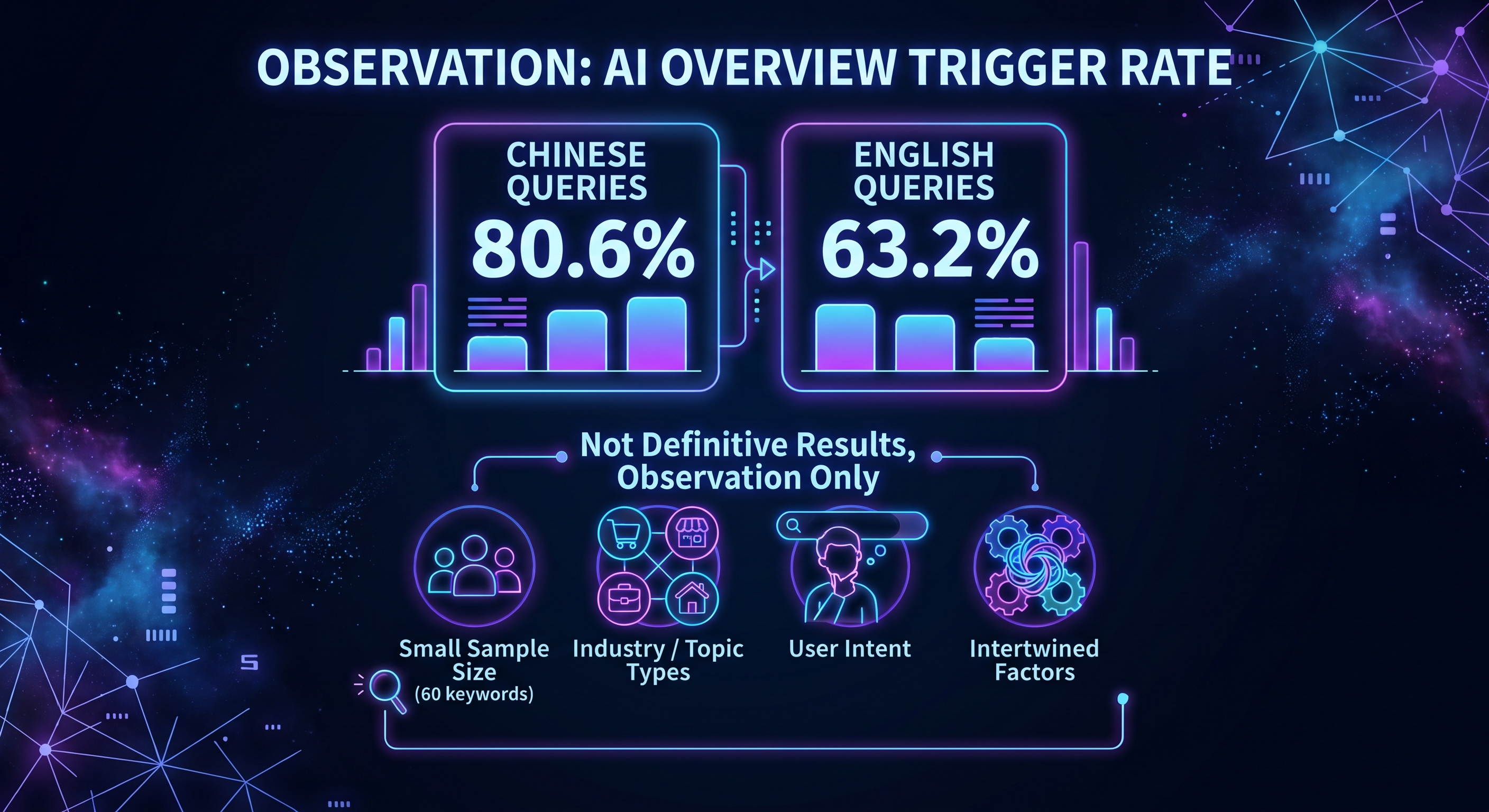
Chinese keywords triggered an AI Overview in 29 of 36 (80.6%); English keywords in 12 of 19 (63.2%). We are labelling this an observation rather than a result, because it does not survive scrutiny as one.
Our Chinese keywords skew toward consumer categories and our English keywords toward B2B marketing terms, so language and topic are confounded by construction. The gap could be entirely a topic effect with language contributing nothing, and n=60 cannot separate the two. A valid test needs matched translation pairs across identical categories, captured on the same day. We have not run it.
The one thing we would act on: if you run a bilingual Hong Kong site, nothing here says the Chinese side is the safer one. That is a reason to measure it, not a reason to conclude anything.
Result 3: a local pack is not a shield — the intent behind the query is what moves

Seventeen of our keywords returned a local pack. Twelve of those returned an AI Overview as well: 脊醫, 健身室, 國際學校, 補習社, 脫毛, 醫美, 瑜伽班, 私人教練, 人壽保險, 汽車保險, 網購平台 and gym membership hong kong. Five did not: seo hong kong, seo agency hong kong, digital marketing agency hong kong, 中醫 and 美容院.
Read the two lists and the split is about the job, not the map. Every keyword in the five is a provider-finding query — the searcher wants a business, usually with a place name attached. The twelve are category-understanding queries that happen to have local businesses behind them. 美容院 (find a salon) showed no AI Overview; 醫美 (understand medical aesthetics) did. Same industry, different job, different SERP.
This is worth stating carefully, because the shortcut version — "we're a local business, so AI Overviews don't affect us" — is a wrong reading of a correct statistic. Ahrefs' analysis of 146 million SERPs found that only 7.9% of local searches trigger an AI Overview, and that navigational and transactional queries trigger at 0.9% and 2.1% against 21.4% for informational ones. Seventeen keywords cannot overturn that, and we are not claiming they do.
What our seventeen show is where the line falls inside a single local business's keyword set. A local pack on the page tells you nothing on its own, because Google serves both features when the query is someone learning about a category rather than picking a vendor. So the useful question is not "do I get a map pack?" It is: how many of my keywords are people learning, and how many are people choosing? Only the second half is quiet, and for most service businesses in Hong Kong it is not the bigger half.
Result 4: the missing data is itself a finding
Four of the five keywords with no usable SERP data were emerging AI search terms, including "generative engine optimization," "answer engine optimization," "AI SEO tools," and "AI Overview." If you're wondering what generative engine optimization actually means and how it differs from traditional SEO, we cover that in a separate breakdown.
These terms have search volume. What they do not have is a settled results page — which is close to the definition of a category still forming. If you are choosing what to be known for in Hong Kong AI search, this is what an unclaimed position looks like in data.
What this means, and where to go next
This 60-keyword sample cannot tell you the average AI Overview rate in Hong Kong, and it is not meant to. What it can show is how far apart two categories sit: five of five in insurance, nothing at all on the two highest-volume property terms we tested. The spread between sectors was wider than the spread in our own headline number, which makes the average the least useful figure on this page.
So the question worth your time is not whether 68% or 75% is the truer number. It is which half of your keyword set is people learning about your category — because that is the half where an answer now appears above your listing. Pull your own list, check the SERP features, and count.
The service side of this — how we work a page into the sources an AI Overview draws from — is our AI Overview optimisation work.
If you'd rather have us look at the whole picture, that's what our AI SEO services cover.
Limitations
Read these before quoting anything above.
- n=60 is small. These rates carry wide confidence intervals. Treat them as directional, not precise.
- The snapshots span ten weeks, not a day. Ahrefs' serp_last_update values run from 1 June to 10 August 2026. We did not control capture date across the groups we compare, so part of any gap between two groups could be a period effect — Google changing what it serves — rather than a real difference between the groups.
- Third-party snapshots, not live checks. We read Ahrefs' serp_features field rather than searching each keyword manually. A manual audit would be more accurate and much slower.
- Judgment-based selection. Eight industries, five keywords each, chosen by us. This is not a random sample of Hong Kong queries and cannot support a market-wide rate.
- Language and topic are confounded, which is why the language comparison above is labelled an observation rather than a result.
- AI Overviews are probabilistic and personalised. Google's documentation says they appear only when its systems judge them additive to classic Search, and that they "often don't trigger". Personalisation by history, location and device means any snapshot is one view of a moving feature, not the view.
- Two denominators. Five keywords returned no usable record, so every rate here can be read two ways. We say which one we used each time.
These are not footnotes. They are how the numbers should be read. We will re-run this with matched translation pairs and a same-day capture window; if you want the raw keyword list to check our work, it is available on request.
FAQ
1. How did you test whether a keyword triggers an AI Overview?
We read the serp_features field returned by Ahrefs Keywords Explorer for each of 60 Hong Kong keywords, with SERP snapshots dated 1 June to 10 August 2026, and counted a trigger only where that field contained ai_overview. Five keywords returned no usable record; we excluded those from the denominator rather than scoring them as non-triggers, because an empty field is missing data, not evidence of absence.
2. What percentage of Hong Kong searches show an AI Overview?
41 of 60 — 68.3% of everything we tested, or 74.5% of the 55 keywords with a usable SERP record. That is the rate for this sample, not for Hong Kong search as a whole: our 60 keywords were chosen by judgment across eight industries, not sampled at random. For scale, Ahrefs found AI Overviews on 20.5% of 146 million SERPs globally, which is why your own category matters more than either average.
3. Do AI Overviews appear for local searches in Hong Kong?
In our sample, 12 of the 17 keywords that returned a local pack returned an AI Overview alongside it. The five exceptions were all provider-finding queries — seo hong kong, 美容院 and similar. Ahrefs' global data puts local-search triggering at 7.9%, so read our figure as a signal about intent, not as a Hong Kong market rate.
4. How can I check whether my keywords trigger AI Overviews?
Search them in an incognito window set to Hong Kong, or pull the SERP-features field from a rank tracker. Sample the same keyword across several days rather than once: AI Overview presence varies between checks, and personalisation means your view is not every user's view.
Want to check your own category?
Our study shows that AI Overview visibility can vary significantly by category. Check how exposed your own category is with our free SEO audit.
References: