
ChatGPT vs Perplexity vs Gemini: What SEO Work Differs
Short answer: no, you don't need three. ChatGPT SEO, Perplexity SEO and Gemini SEO share the same underlying writing work; what genuinely differs between them is configuration and measurement, not content. Based on our GEO engagements at Maxlytics, roughly 80% of what gets a page cited is identical across every engine — that split is our characterisation of where effort lands, not a measurement.
This guide is written for in-house marketers and agency teams who already publish content and can edit their own robots.txt. It covers three things: what's identical across every engine, the four areas that genuinely need per-engine handling (crawler access, index dependency, refresh cadence and attribution style), and which claims here come from vendor documentation versus our own observation.
What gets content cited on ChatGPT, Perplexity and Gemini alike?
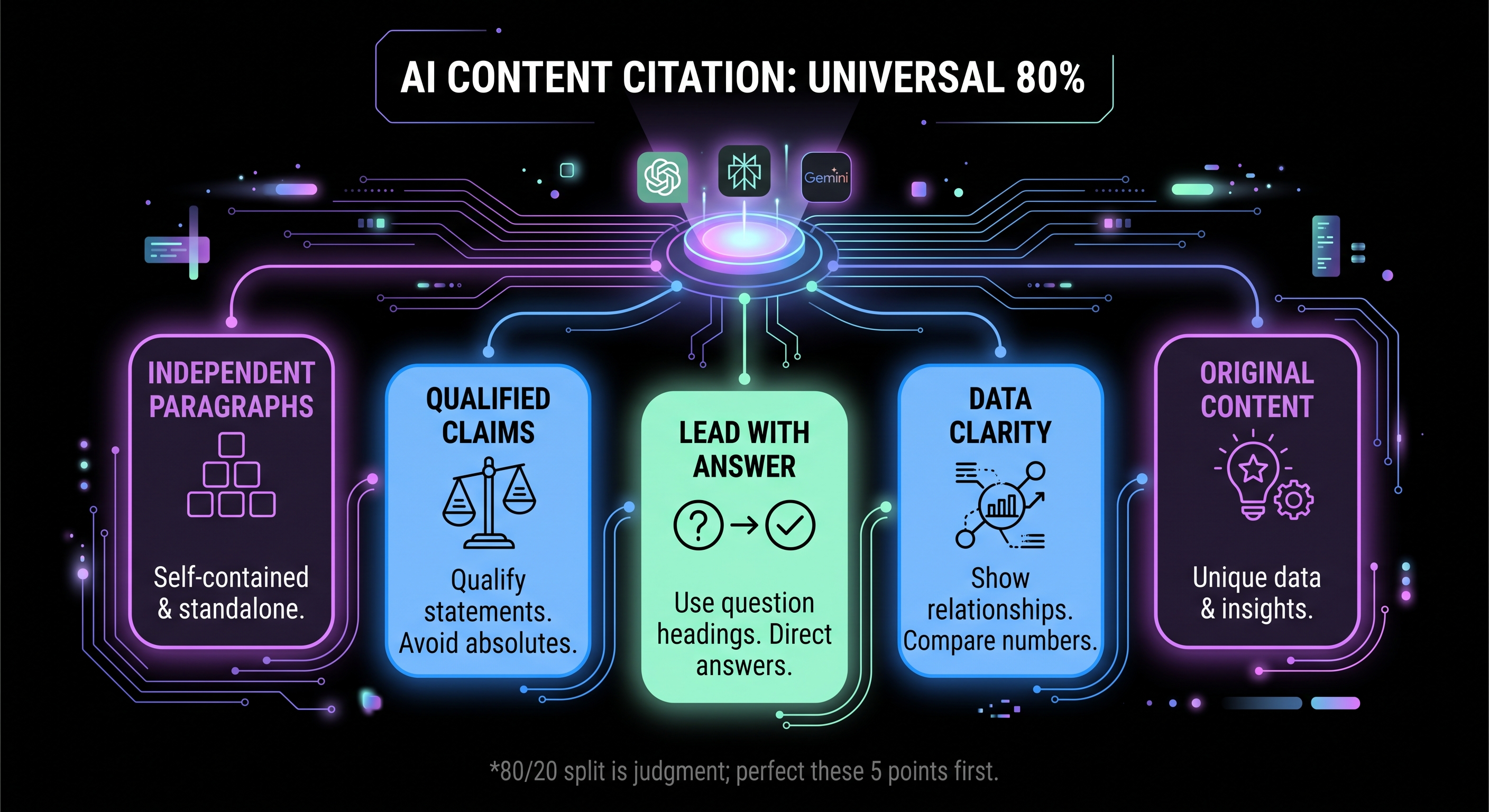
Getting content cited by ChatGPT, Perplexity, and Gemini comes down to the same handful of practices:
- Make paragraphs self-contained. Each one should hold up on its own if pulled out of context.
- Qualify your claims. Say "when resources are limited" rather than stating things as absolutes.
- Lead with the answer, and phrase headings as questions. AI engines favour an answer-first, explain-after structure.
- State relationships clearly. Show how numbers compare to each other, rather than stacking terms without context.
- Give it something worth citing. Original data, real test results, or an industry observation nobody else has published.
That 80/20 split is a judgment call based on our own experience, not a figure we've formally measured. But the point stands: until these five things are handled well, fine-tuning content per engine is effort spent in the wrong place.
What actually differs between ChatGPT SEO, Perplexity SEO and Gemini SEO?
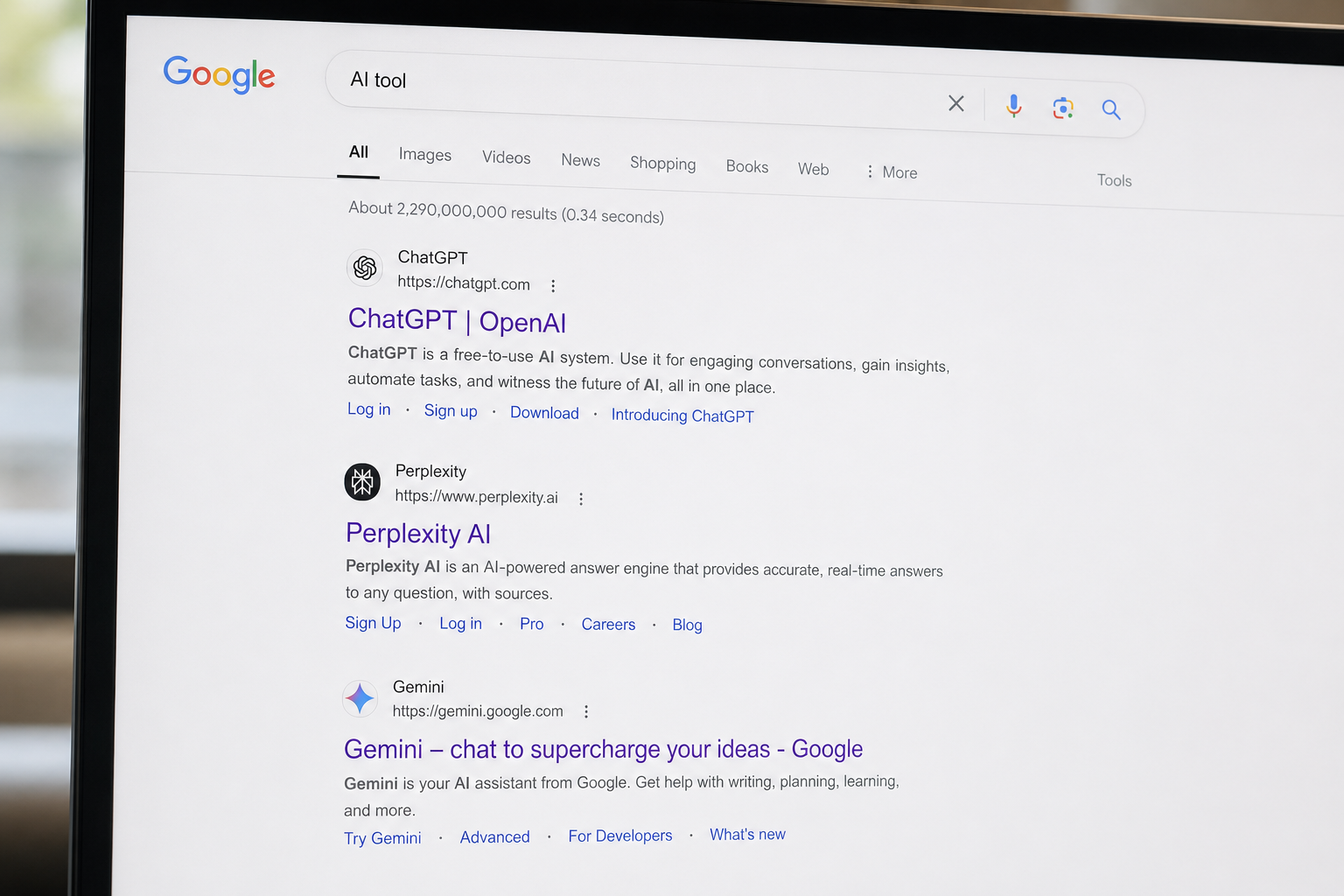
A note on scope before the detail: this article covers four surfaces, not three. Gemini apps and Google's AI Overviews are both Google products, but they're governed by different controls, so they need to be treated separately throughout.
| Engine | Crawler to allow | Bound to search index? | Recency weighting | Attribution style |
| ChatGPT | GPTBot (training), OAI-SearchBot (search surface) | Partially — retrieves through a third-party index (Bing most prominently) alongside OpenAI's own OAI-SearchBot index | Moderate; higher on news-shaped queries | Inline links, often few sources |
| Perplexity | PerplexityBot | Its own index, built by its own crawler, with aggressive live fetching | High — visibly favours fresh pages | Dense and prominent — numbered citations throughout |
| Gemini apps / AI Mode | Googlebot crawls; Google-Extended governs training and grounding | Tightly — grounded in Google Search | Moderate | Source tray, fewer in-text attributions |
| Google AI Overviews | Googlebot only — Google-Extended does not apply; use nosnippet / data-nosnippet / max-snippet / noindex | Tightly | Moderate | Link cards beside the answer |
Four practical consequences follow, in descending order of how much they matter.
1. Access is set crawler by crawler, and it's the one hard gate
In plain terms: every AI engine runs its own crawler — a program that reads your web pages — and you have to check and grant access to each one individually. There's no single switch that covers all of them.
Think of it like membership cards at different shopping malls. A membership at one mall doesn't get you anywhere at another. Blocking ChatGPT's crawler doesn't stop Perplexity's or Gemini's from reaching your site, and opening access for one doesn't automatically open it for the rest.
Here's where the industry gets confused most often: many people assume "Google-Extended" is the switch that controls whether a site appears in AI Overviews (the AI summary box at the top of Google Search results). It isn't.
- Google-Extended controls whether your content can be used to train AI models, and whether it can be read and cited by Google's AI products like Gemini and Vertex AI.
- AI Overviews, on the other hand, is part of Google Search itself and runs on the standard Googlebot — see how AI Overviews actually select what to cite for the mechanism. What actually controls whether it displays your content are separate tags: nosnippet, data-nosnippet, max-snippet, and noindex.
These two things control entirely different scopes, and they're easy to mix up. That's why every audit we run checks each of them separately rather than assuming one setting covers everything — platform rules can shift at any time.
2. Only two of these engines actually depend on your Google rankings
Gemini and Google's AI Overviews assemble answers from Google's own search index, so your conventional search performance directly shapes the pool they draw from. ChatGPT and Perplexity don't work this way. ChatGPT's search surface retrieves through a third-party search index — Bing most prominently — alongside OpenAI's own index built by its OAI-SearchBot crawler. Perplexity runs its own index entirely, crawled by PerplexityBot; blocking or allowing it has no effect on your Google rankings, and your Google rankings have no direct effect on it.
That distinction matters more than it first appears. Backlinks — the traditional SEO signal of other sites linking to yours — carry less weight in how ChatGPT and Perplexity rank the sources they retrieve than they do in Google's results (this is where GEO and SEO measurement genuinely diverge). But every one of these engines still retrieves from some search index. A page that isn't crawled and indexed anywhere isn't retrievable by any of them.
Weak conventional Google rankings genuinely give you a better relative shot on Perplexity and ChatGPT than on the Google surfaces — but only once your pages are indexed and findable for the query at all. Loose coupling to Google isn't the same as independence from search.
3. Perplexity clearly favours fresh content — enough to change your publishing cadence
Perplexity crawls in near real-time and noticeably favours pages that have been recently updated. Make sure your dateModified field actually reflects reality — a quarterly refresh cycle may not be frequent enough here.
4. Attribution style changes how much a single citation is actually worth
A citation on Perplexity is easy to trace back to clicks; a mention on Gemini or in AI Overviews tends to function more like brand exposure. If your reporting only looks at session counts, you'll systematically undervalue what's happening on the Google side.
What we deliberately don't do for AI search visibility

Some approaches look more diligent on the surface but end up wasting resources. We avoid these on purpose:
- Writing three separate drafts, one per engine. This just splits one strong signal into three weaker ones.
- Rewriting your core content for each engine. The five principles above only need to be done once, correctly.
- Chasing which index ChatGPT happens to be using this quarter. That said, we don't ignore the fact that it's using one — index visibility is still the entry ticket.
- Assuming a platform's own documentation applies exactly to your site. Every site starts from a different baseline.
Where the per-engine effort actually goes: audits, measurement, maintenance

None of the three things that actually drive results here are "writing":
- Engine-by-engine access audits, scheduled for regular review
- Separate performance measurement per engine, so you're not judging everything by a single metric like session count
- A maintenance rhythm for time-sensitive content — this is where Perplexity shows the clearest payoff
One pattern shows up often enough to be worth naming. A site runs a crawler-access audit alongside a round of genuine content refreshes, and over the following quarter its Perplexity citations climb noticeably while its AI Overview appearances stay flat.
That asymmetry is diagnostic, and it's almost never a content quality problem — the same passages are demonstrably being cited elsewhere. It usually means the Google-side retrieval pool isn't reaching the site at all, which is a conventional index visibility problem. It needs a different fix from writing more articles, and no amount of passage-level editing will move it. Different engines call for different playbooks, and the first job is working out which one you actually need.
Does query language change which engine cites you?
Query language is a second axis alongside engine, and the difference is mechanical rather than a translation problem: each language draws on different training corpora and different retrieval pools, so blending them averages two unrelated systems — the same error as blending four engines into one score.
Our Hong Kong AI Overview triggering study, sampling SERPs from June to August 2026, is consistent with that without establishing it. Across the queries where we had usable SERP data, 29 of 36 Chinese-language queries returned an AI Overview (80.6%), against 12 of 19 English-language queries (63.2%). One caveat has to be stated alongside that number: the Chinese subset skewed toward consumer commercial categories while the English subset skewed toward B2B marketing terms, so language and topic are confounded by the design of the sample — this gap could be entirely a topic effect rather than a language effect. Treat it as an unresolved observation, not a causal claim.
The operational consequence is straightforward. Most visibility tools sample from US infrastructure in English by default, which is worth checking before you trust any dashboard's regional breakdown. Prompts about a Hong Kong purchase, sent from the US in English, measure a market you don't sell in. Set sampling region and query language deliberately, and report them separately.
Where does the per-engine work sit in our Citation Loop?

We call this ongoing cycle the Citation Loop — our working name for the 4-Step Generative Optimization Process we run with clients, not a Google-defined framework or an industry standard. It runs as four stages: Generative Visibility Audit, Knowledge Architecture, Schema & E-E-A-T Injection, and Citation Monitoring.
The per-engine work isn't evenly spread across those four stages.
1. Generative Visibility Audit — baseline each engine separately, before anything changes. Per-engine.
2. Knowledge Architecture — the shared 80%. Engine-agnostic, and by a wide margin the heaviest lift.
3. Schema & E-E-A-T Injection — mostly shared; the per-engine part is crawler permissions (GPTBot, OAI-SearchBot, PerplexityBot) plus Google's separate snippet-level controls.
4. Citation Monitoring — per engine, feeding back into stage 2.
The engine-specific work sits in stages 1, 3, and 4. Stage 2 — the writing, which is most of the effort — is the same job for all of them. That's why we advise clients not to split their content resources three ways on day one. Get the shared content foundation right first, then allocate audit, schema, and monitoring resources by engine from there.
Which of these claims are documented, and which are our observations?
Here's the line we draw between the two:
- Backed by documentation: crawler user-agent names (like OAI-SearchBot and PerplexityBot), and how Google-Extended and the nosnippet family of tags function — all of this is written into official documentation and can be verified directly.
- Based on observation: exactly how strongly Perplexity favours fresh content, and how much exposure value different attribution styles actually deliver. These are patterns we've tracked over time. No platform publishes its full ranking logic, so these figures can shift.
The first category is settled fact. The second is informed judgment worth taking seriously — but not treated with the same certainty.
FAQ
1. If we can only resource one engine, which should we prioritize?
It depends on your existing ranking baseline and how your target audience behaves. If your Google rankings are already solid, getting access controls configured correctly is the cheapest, fastest win. If trackable click-through is the goal, Perplexity's attribution style tends to deliver more measurable returns.
2. Does blocking AI crawlers protect our content without any downside?
Not exactly. Blocking a given crawler only affects visibility on that one engine — the others are unaffected. But it also means giving up whatever exposure and traffic that engine could have sent you. It's a trade-off, not pure protection.
3. We're cited on Perplexity but not appearing in AI Overviews at all — what does that tell us?
It's rarely a content quality issue. More often, it points to limited visibility in Google's search index, or a control setting (like noindex or max-snippet) affecting how your content displays. These are two separate problems that need to be diagnosed independently.
4. How often should we recheck crawler access?
At least once a quarter, and especially after any platform policy changes (Google-Extended's scope, for example, has shifted before). If access settings are wrong, nothing else you optimize can actually show results.
Curious what your site's crawler access actually looks like right now — which AI engines can see you, and which can't?
Book a free SEO Audit with Maxlytics. In 15 minutes we'll show you which AI crawlers your robots.txt currently allows, and which of the four surfaces you're eligible to appear on today.
Book your free SEO Audit → | Learn about Maxlytics' AI SEO / GEO services →