
GEO vs SEO vs AEO: Differences and Where to Focus in 2026
GEO vs SEO is mainly about the type of visibility being targeted: Search Engine Optimization (SEO) focuses on organic search discovery and ranking, while Generative Engine Optimization (GEO) focuses on whether a brand or source appears or is cited in AI-generated answers; Answer Engine Optimization (AEO) focuses on making answers clear and easy for search or AI systems to identify.
GEO and AEO are not separate ranking systems introduced by Google. Google’s 2026 guidance on generative AI search makes clear that AI Overviews and AI Mode continue to rely on Google Search’s existing systems and SEO fundamentals. From Google Search’s perspective, optimizing for generative AI experiences remains part of SEO.
The more useful question, therefore, is not which new term will “replace SEO”, but which problem SEO, AEO or GEO is meant to solve, and where a business should focus its resources first.

Quick Answer: GEO vs SEO vs AEO
- SEO → helps a page get crawled, indexed and ranked in search.
- AEO → makes a clear answer easier for search and AI systems to extract.
- GEO → focuses on whether a brand or source is mentioned or cited in AI-generated answers.
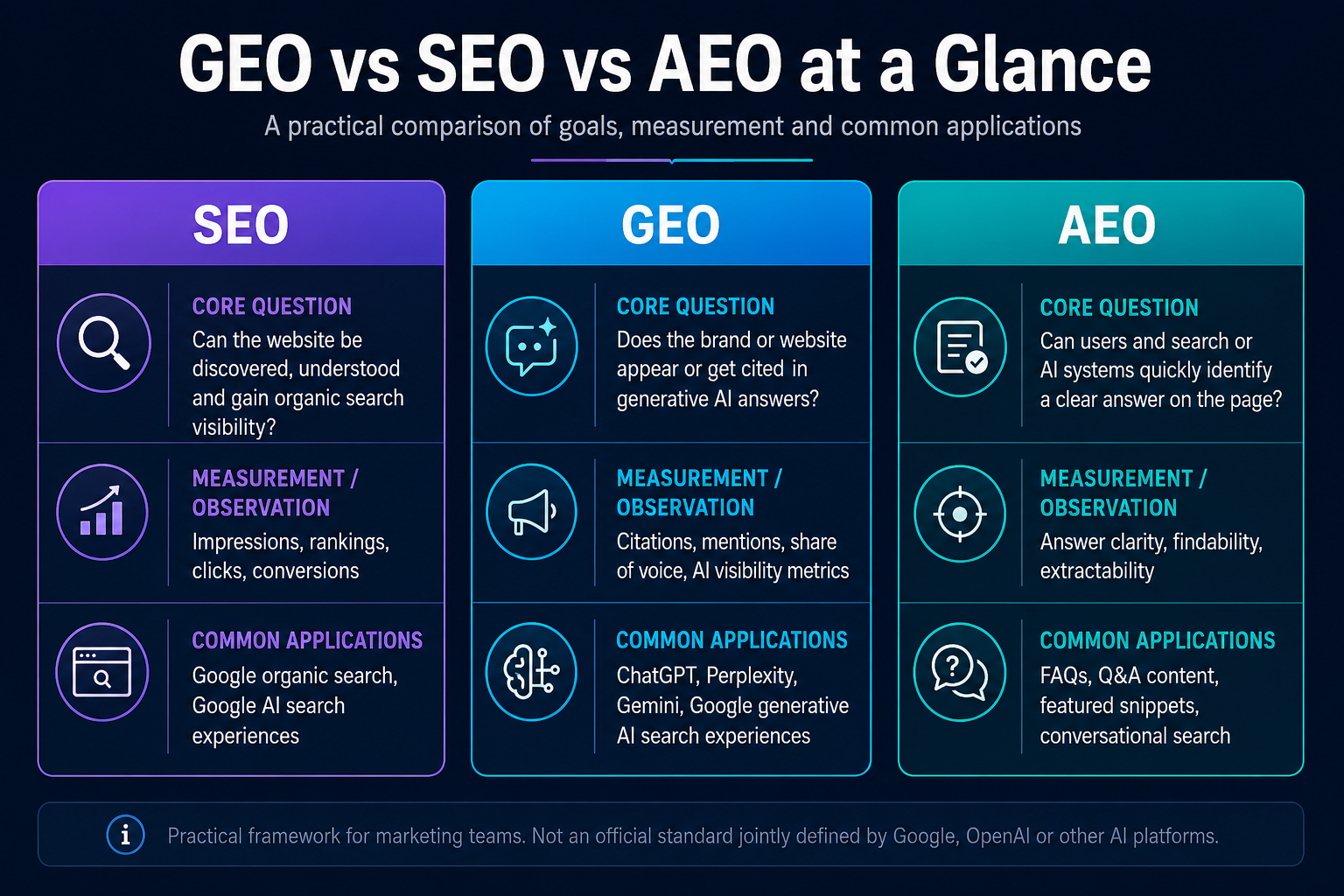
GEO vs SEO vs AEO at a Glance
| Approach | Core question | Common measurement / observation areas | Common applications |
| SEO | Can the website be discovered, understood and gain organic search visibility? | Impressions, rankings, clicks, conversions | Google organic search and Google’s AI search experiences |
| GEO | Does the brand or website appear or get cited in generative AI answers? | Citations, mentions, share of voice and other AI visibility metrics | ChatGPT, Perplexity, Gemini and Google’s generative AI search experiences |
| AEO | Can users and search or AI systems quickly identify a clear answer on the page? | Answer clarity, findability and extractability | FAQs, Q&A content, featured snippets and conversational search |
This classification is a practical framework for marketing teams to distinguish between different areas of search and AI visibility work. It is not an official standard defined jointly by Google, OpenAI or other AI platforms.
GEO measurement is also not fully standardised. Some AI visibility tools use metrics such as Citation Rate, which generally measures how often a website is cited within a defined test set. However, results can vary depending on the prompts, platforms, locations, testing frequency and citation definitions used. Citation Rate should therefore be interpreted together with the methodology behind it, rather than treated as a standalone percentage.
There is also a Hong Kong-specific ambiguity around the term AEO. Hong Kong Customs operates the Hong Kong Authorized Economic Operator (AEO) Programme, so a search for “AEO” in Hong Kong does not necessarily refer to Answer Engine Optimization.
For that reason, this article defines AEO clearly on first use and uses the abbreviation thereafter.
Why Are SEO, GEO and AEO Discussed Separately?
The main reason is that the ways people discover and consume information through search are expanding.
Traditional search:
Enter a query → Review search results → Visit websites → Compare information
AI-assisted search:
Ask a question → AI may retrieve and combine information from multiple sources → Receive a generated answer → Decide whether to explore the sources
Traditional search has not been replaced. Instead, search experiences now include more ways to provide direct answers and synthesise information from multiple sources.
For example, Google AI Overviews and AI Mode may use query fan-out. In simple terms, one question can lead to multiple related searches across different subtopics, allowing Google to retrieve a broader set of relevant information before generating a response.
Marketing teams may therefore still ask:
- Which keywords are gaining organic search visibility?
- Which pages are generating clicks and conversions?
- How are our SEO pages performing?
But they may also ask:
- Is our brand being cited or used as a source in AI-generated answers?
- Are competitors appearing more often than we are?
- Does our AI visibility differ by platform, language or market?
This is where GEO becomes useful. It extends measurement beyond rankings and traffic to include brand mentions, citations and visibility within generated answers.
In practice, GEO can sit within a broader AI SEO strategy that covers Google’s generative search experiences as well as other AI platforms.
The measurement approach should still be platform-specific. Google documents aspects of how its own generative Search features work, but those mechanisms should not automatically be assumed to apply to ChatGPT, Perplexity, Gemini or other platforms. Each platform should be evaluated based on its own documented behaviour and measurable outputs.

What Do SEO and Content Teams Pay More Attention to When Working on GEO?
GEO does not mean rebuilding SEO from scratch or rewriting every article into a special “AI format”.
Google’s guidance on optimizing for generative AI search states that its generative AI features in Search are rooted in Google’s existing Search ranking and quality systems, and that established SEO best practices continue to apply. Google also describes AEO and GEO as terms used for work focused on AI search visibility rather than separate Google ranking systems.
Many so-called “GEO practices” are therefore not completely new SEO rules. Instead, they place greater emphasis on several areas that already matter in search, content quality and measurement.
1. Support Important Claims With Sources and Context
A statement such as:
“AI Search is rapidly changing the Hong Kong market.”
is too broad on its own. It does not tell the reader which platform was tested, when the observation was made, how large the sample was or what evidence supports the conclusion.
A stronger version would be:
“In a sample of 60 Hong Kong keywords checked between 1 June and 10 August 2026, 68% to 75% returned a Google AI Overview, depending on how five keywords with no usable data are treated.”
The stronger version makes the claim easier to verify by stating the market, platform, time period, sample size and reason for the reported range.
Google also recommends creating original, useful content that adds first-hand experience, unique viewpoints or information beyond what is already widely available online.
2. Explain How Concepts Relate Instead of Listing Jargon
Simply listing:
SEO, Schema, E-E-A-T, GEO, Entity, AI Overview
does not explain how those concepts relate to one another.
A clearer explanation would be:
Structured data can help Google understand structured information on a page, but a website does not need AI-specific schema to be eligible to appear in AI Overviews or AI Mode.
Google’s current guidance does not require a separate AI-specific structured data standard for generative AI features in Search. Existing technical SEO and structured data best practices continue to apply.
3. Do Not Treat AI Visibility as Revenue
A statement such as:
“GEO can increase conversion rates.”
is too direct without supporting business data.
A more accurate version would be:
GEO can be used to measure and improve a brand’s visibility in generative AI search. Whether that exposure leads to clicks, leads or revenue still needs to be assessed using analytics, CRM and actual conversion data.
In simple terms:
Being mentioned by AI ≠ receiving a click ≠ generating a lead ≠ closing a sale.
Citations and mentions can indicate AI visibility, but they cannot on their own prove an increase in revenue.
4. Add Another Layer of AI Search Visibility Measurement
One of the clearer additions GEO brings is a broader measurement layer beyond traditional organic search performance.
SEO teams commonly monitor:
- Google Search impressions
- organic rankings
- clicks
- conversions
With GEO, businesses may also monitor:
- ChatGPT citations
- Perplexity citations
- brand mentions
- competitive share of voice
- Google generative AI visibility
On 3 June 2026, Google began rolling out a dedicated Generative AI Performance Report in Search Console to a subset of websites. The Search report covers visibility in features such as AI Overviews and AI Mode.
The report currently provides impressions, together with breakdowns by pages, countries, devices and dates. Google does not currently list clicks, CTR or average position as metrics in this dedicated generative AI report.
That distinction matters because:
AI visibility ≠ clicks ≠ leads ≠ revenue.
More impressions in generative AI features can show that a site is being surfaced more often, but that does not by itself prove an increase in traffic or commercial performance.
So one of the more practical questions GEO adds is not:
“What special AI format should we rewrite our articles into?”
but:
“Beyond our existing organic search performance, should we also measure how visible our brand is across different AI search experiences?”
For businesses, SEO still covers the foundations of search and organic visibility, while GEO adds another layer of citation, mention and generative AI visibility measurement.

What Does AEO Actually Change?
If GEO is more concerned with:
Does the brand appear or get cited in AI-generated answers, and how do we measure that visibility?
AEO is closer to asking:
When a user asks a question, can the page provide a clear answer quickly?
AEO is most useful as a practical approach to content structure, answer clarity and search experience. It focuses on making the main answer easier for readers, search engines and AI systems to identify before adding supporting detail.
For example, if an H2 asks:
What is the difference between SEO and GEO?
the paragraph immediately below should answer that question directly, rather than opening with:
As technology continues to evolve at an unprecedented pace, the world of digital marketing is undergoing a major transformation...
Practical AEO improvements may include:
- Using headings that clearly state what each section answers
- Putting the main answer first
- Giving the definition before adding conditions or detail
- Using tables when information genuinely needs comparison
- Removing repetitive sentences that add no new information
For example:
Less direct:
GEO has attracted increasing attention from marketing professionals in recent years. As AI search continues to develop, more businesses are starting to explore related strategies.
More direct:
GEO focuses on a brand’s visibility in generative AI search, including whether the brand is mentioned or cited and how often it appears compared with competitors.
The principle is simple: give readers the answer first, then add the background, conditions or examples needed to understand it.
On question-led pages, we may use a short direct answer before adding further explanation. This is an editorial approach rather than a Google-defined word-count requirement for AI Overviews.
Google also states that there is no ideal page length for generative AI search. Answer length should therefore depend on how much information a reader needs to understand the topic, rather than on a fixed number of words.

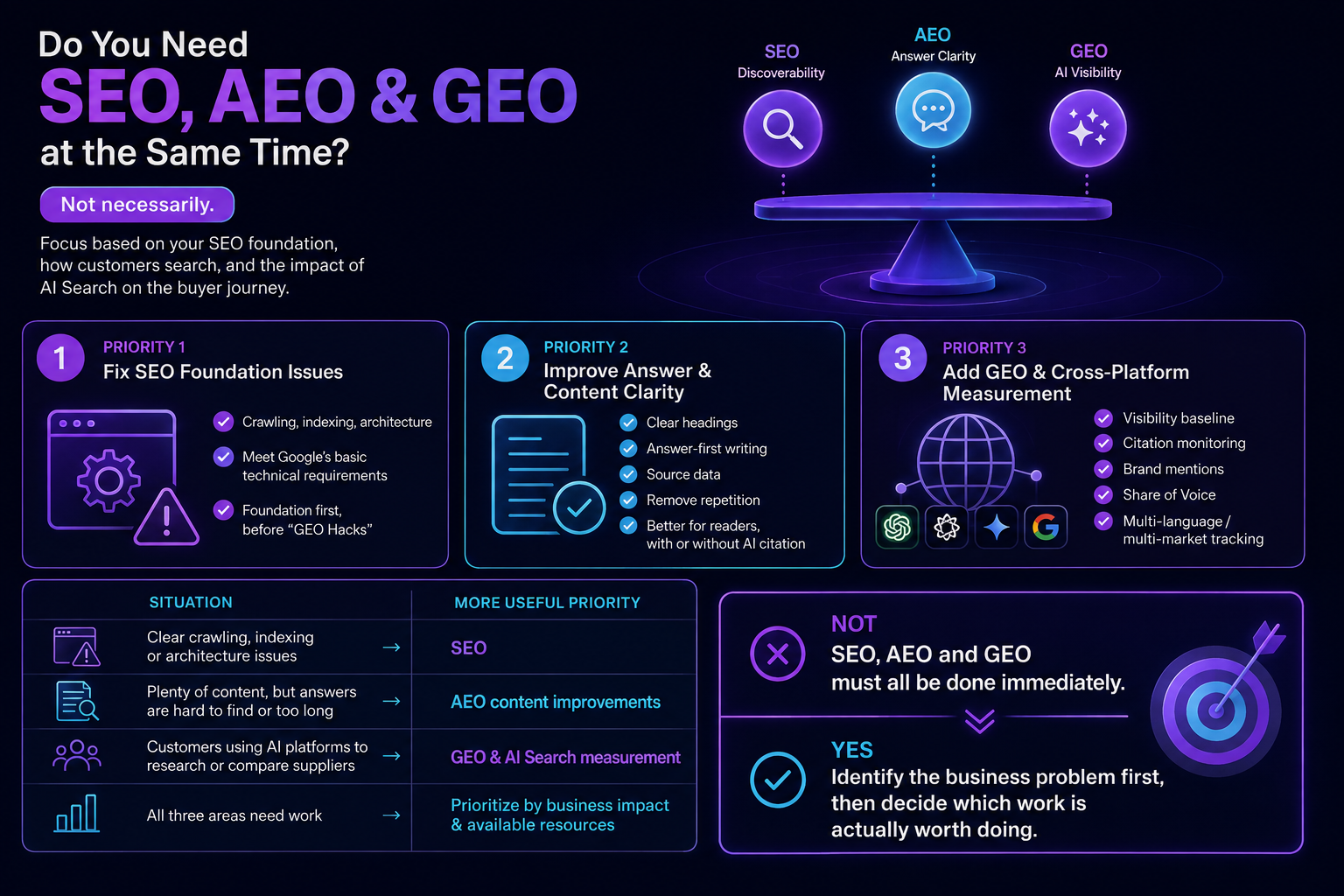
Do You Need SEO, GEO and AEO at the Same Time?
No — and the order matters more than the count.
For most Hong Kong businesses, the practical sequence is to fix SEO foundations first, improve answer clarity second, and add GEO measurement when there are relevant AI Search queries worth tracking.
Businesses do not need three separate teams or three separate services simply because the market now uses the terms SEO, GEO and AEO. A more practical approach is to assess the website’s current SEO foundation, how target customers search, and whether AI Search is already influencing the buyer journey before deciding where resources should go.
Priority 1: Fix SEO Foundation Issues First
If the website still has major Technical SEO issues, such as crawling, indexing or site architecture problems, those issues should usually be addressed before investing heavily in GEO-specific work.
For Google AI Overviews and AI Mode, a page still needs to be indexed, eligible to appear in Google Search with a snippet, and meet Google Search’s basic technical requirements. Google does not require a separate set of AI-specific technical requirements for these features.
Businesses focusing specifically on Google’s generative search features can also review the key considerations around AI Overview Optimisation.
Priority 2: Improve Answer and Content Clarity
If a website already has substantial content but important answers are difficult to find, introductions are too long or information is repetitive, AEO practices can be built into the existing content workflow.
This may include clearer headings, answer-first writing, concise definitions and less repetitive content. These improvements can make key information easier for readers, search engines and AI systems to identify and understand.
Priority 3: Add GEO Measurement When There Is a Real Need
If target customers are already using ChatGPT, Perplexity, Gemini or Google’s AI search features to research information, compare products or shortlist suppliers, it may be useful to measure the brand’s visibility across those platforms.
Generative Engine Optimization can include visibility baselines, citation monitoring, brand mention tracking, competitive share of voice, and multilingual or multi-market measurement.
The question is not:
“GEO is new, so we have to do it.”
A more useful question is:
Are our target customers already using AI Search to discover, research or compare products and services like ours?
If the answer is not yet clear, establish a baseline first rather than immediately rewriting the entire website.
So Which Area Should You Prioritise?
| Situation | More useful priority |
| The website has crawling, indexing or architecture problems | SEO |
| The website has useful content, but answers are difficult to find | AEO content improvements |
| Target customers are already using AI platforms to research or compare suppliers | GEO and AI Search measurement |
| All three areas need work | Prioritise by business impact, dependency and available resources |
The practical rule is simple:
Identify the business problem first, then invest in the SEO, AEO or GEO work that addresses it.
What Is Different About the Hong Kong Market?
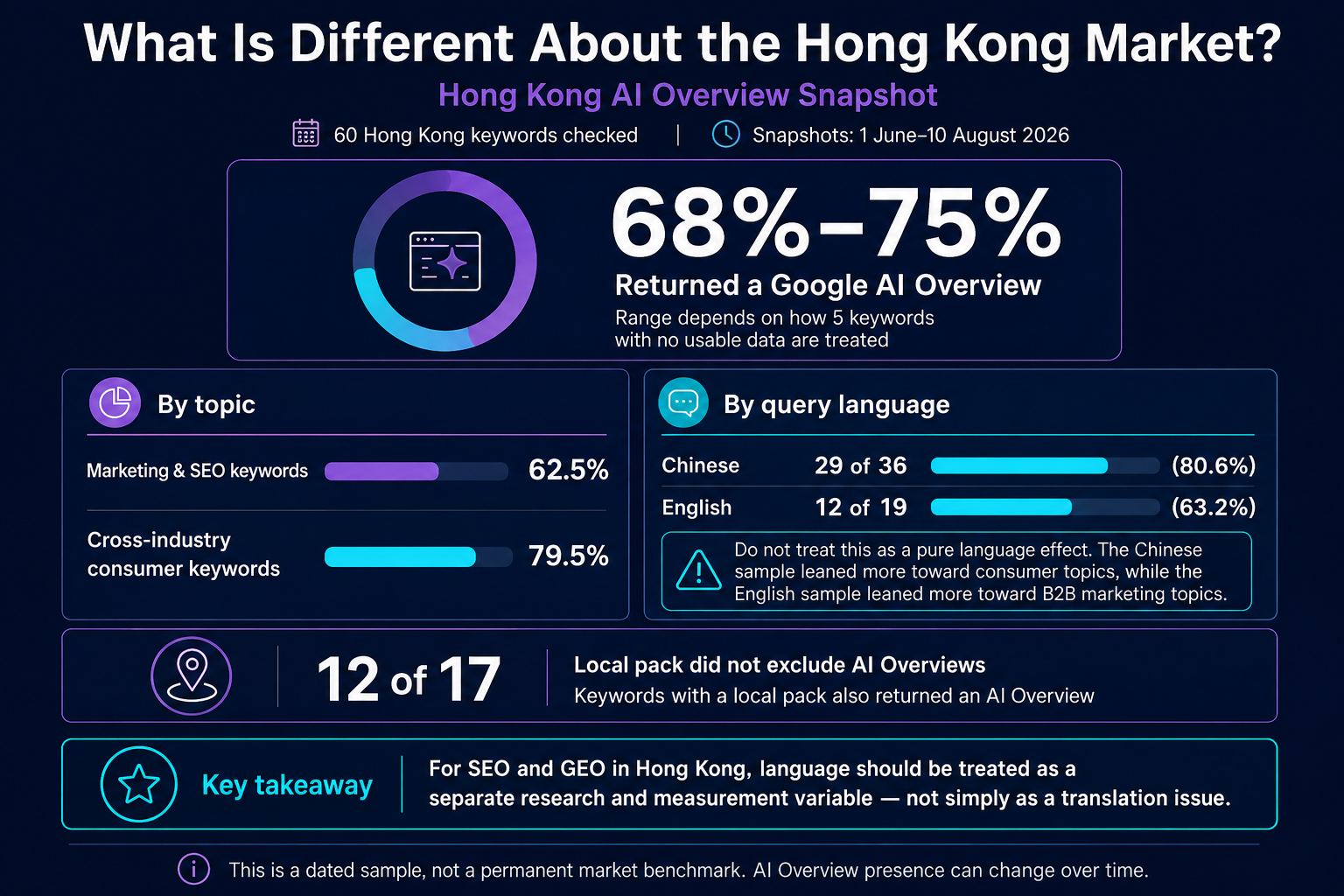
In August 2026, our Hong Kong AI Overview study checked 60 Hong Kong keywords for Google AI Overview presence using snapshots taken between 1 June and 10 August 2026. Between 68% and 75% returned an AI Overview, depending on how five keywords with no usable data are treated.
The results also varied across the sample. Marketing and SEO keywords triggered an AI Overview 62.5% of the time, compared with 79.5% for cross-industry consumer keywords.
Chinese-language queries returned an AI Overview in 29 of 36 cases with usable data (80.6%), compared with 12 of 19 English-language queries (63.2%). However, we do not interpret this as evidence that Chinese queries are inherently more likely to trigger AI Overviews. Our Chinese sample leaned more heavily toward consumer topics, while the English sample contained more B2B marketing queries, so language and topic are confounded in this sample.
Local packs and AI Overviews also appeared together in the sample. Of the 17 keywords that returned a local pack, 12 also returned an AI Overview.
This is a dated sample rather than a permanent market benchmark. AI Overview presence can change over time, and a 60-keyword sample is not large enough to isolate language, industry and search intent as independent causes.
For SEO and GEO in Hong Kong, this highlights two variables that deserve separate attention: query language and search intent.
For the same product or service, English, Traditional Chinese and more locally phrased Hong Kong searches are not necessarily direct translations of the same query.
For example, the same B2B service may involve:
- English corporate or industry terminology
- related Traditional Chinese search terms
- mixed Chinese-English queries
- similar-looking keywords that carry different search intent
For that reason, Hong Kong keyword research should not follow a simple:
English keyword → Translate into Chinese → Done
A more practical approach is to research English and Traditional Chinese keywords, search intent, competing pages and content needs separately.
The same principle applies to GEO measurement. If a business wants to understand its AI Search visibility in Hong Kong, it should not test only one set of English prompts and treat the results as representative of the entire market.
English and Traditional Chinese queries can be measured separately to understand whether the brand appears or is cited, and whether competitor visibility differs by language. But if the topics and prompts are not matched on a one-to-one basis, the results should not be used to claim that one language itself causes a higher AI Overview trigger rate.
The more accurate takeaway is:
For SEO and GEO in Hong Kong, language should be treated as a separate research and measurement variable, not simply as a translation issue.
How We Turn GEO Into an Ongoing Measurement Process
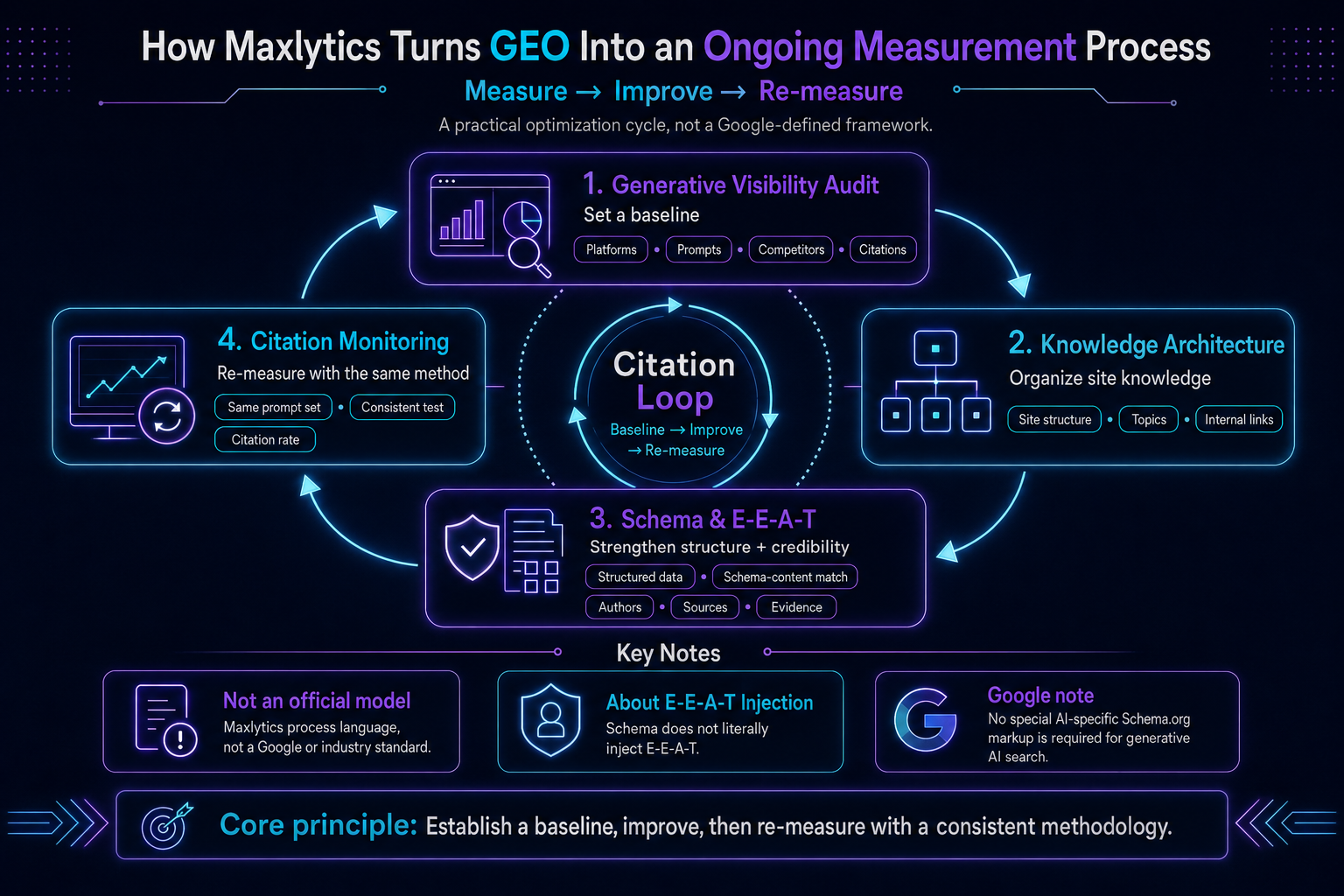
We structure AI Search and GEO work as a cycle of measurement, improvement and re-measurement. We also use the term “Citation Loop” on our AI Overview Optimisation page to describe this ongoing citation-focused process.
The Citation Loop is our own working name for this cycle. It is not a Google-defined framework or a standardised industry model.
Our AI SEO service currently uses four main stages:
Generative Visibility Audit → Knowledge Architecture → Schema & E-E-A-T Injection → Citation Monitoring
In simple terms:
Measure → Find problems → Improve → Measure again
1. Generative Visibility Audit: Establish a Baseline
We first identify which AI search platforms currently surface the brand, which important prompts generate citations, and how competitors appear across the same test set. This creates a visibility baseline for later comparison.
2. Knowledge Architecture: Organise Website Information
We review the site’s information architecture, topic distribution and internal links so that the relationships between the brand, its services and its content are easier for readers and search systems to understand.
3. Schema & E-E-A-T Injection: Strengthen Structure and Credibility Information
“Schema & E-E-A-T Injection” is the name we use for this stage on our AI SEO service page.
In practice, the work may include using appropriate structured data, ensuring that schema matches the visible page content, and strengthening author, source and evidence information.
However, “E-E-A-T Injection” does not mean that schema can literally inject E-E-A-T into a website, and it is not a Google-defined technical mechanism. Google also states that no AI-specific Schema.org markup is required for generative AI search.
4. Citation Monitoring: Re-Measure Using a Consistent Method
After improvements are made, we measure visibility again using a methodology that is as consistent with the original baseline as possible.
For example, if the baseline used 40 fixed prompts, the post-optimisation test should not switch to a different prompt set that is more likely to surface the brand and then compare the resulting citation rates directly. In that case, the difference could come from the methodology rather than a genuine change in visibility.
The core principle behind the Citation Loop is simple:
Establish a baseline, make improvements, then re-measure using a consistent methodology.
What We Still Can't Say for Certain
AI Search is developing quickly, and some questions still do not have reliable or fixed answers.
For example, we cannot reliably promise:
- That an optimised article will be cited by an AI platform within a specific number of days
- That reaching a particular organic ranking in Google Search will automatically make a page appear as a supporting link in an AI Overview or AI Mode
- That adding a particular type of schema will increase citations by a specific amount
- That an AI platform will use exactly the same retrieval or citation methods six months from now
- That following a particular “GEO writing style” will reliably improve citation rates
For Google, pages shown as supporting links in AI Overviews or AI Mode must be indexed and eligible to appear in Search with a snippet. Meeting Google’s technical requirements and best practices, however, does not guarantee that a page will be crawled, indexed or served in a particular Search feature.
So if someone promises:
“Guaranteed stable AI citation rankings”
the more useful questions are:
- Which AI platform and market are being measured?
- Which prompts, languages and locations are being tested?
- How are citations, mentions or “rankings” defined?
- How large is the test set, and what is the baseline?
- Is the same methodology being used before and after optimisation?
Without a clearly defined test set and measurement methodology, claims such as “30% improvement” or “number one ranking” may not be meaningfully comparable.
A credible AI Search strategy should separate four things clearly:
What platforms have publicly documented, what has been observed through testing, what remains a working hypothesis, and what cannot currently be verified.

FAQ
Q1: What is generative engine optimization (GEO)?
Generative Engine Optimization (GEO) focuses on improving and measuring how often a brand, website or source appears, is mentioned or is cited in AI-generated answers. It can apply across platforms such as Google AI Mode, ChatGPT, Gemini and Perplexity. GEO is an industry term, not a separate Google ranking system.
Q2: What is answer engine optimization (AEO)?
Answer Engine Optimization (AEO) focuses on making answers clear, direct and easy for users, search engines and AI systems to identify. A common approach is to use a question-led heading, provide the main answer first, and then add supporting detail. AEO is a practical content optimisation approach rather than a separate Google ranking system.
Q3: Is GEO different from SEO, or just a rebrand?
For Google Search, GEO is largely an extension of existing SEO work rather than a separate ranking system. Google states that its SEO best practices continue to apply to generative AI features such as AI Overviews and AI Mode. Across platforms such as ChatGPT, Perplexity and Gemini, however, GEO can add a separate measurement layer focused on citations, mentions and AI visibility.
Q4: How long does GEO take to show results?
GEO does not have a fixed timeline. AI visibility should be measured through repeated tests using a consistent prompt set and methodology rather than against a promised number of days or months. Results vary by platform, query and market, and no provider can guarantee when a page will be cited.
If a business wants to understand whether its SEO and AI Search foundations are in place, it can start with an SEO and AI Search audit to identify technical issues and visibility gaps, then decide whether further investment in GEO is warranted.