

How to Rank in AI Overviews: A Practical Guide
AI Overviews don't rank your page; they extract a passage from it. Google expands a query into multiple sub-queries, retrieves results for each, and assembles a cited answer from the passages it can lift, which means the unit competing for visibility is a block of your page rather than the page itself.
This applies to informational and how-to queries where an AI Overview appears at all, and only to pages Google has already indexed and deemed eligible to show with a snippet — Google states that eligibility requirement, and states that no special markup or optimisation is needed beyond it. The Hong Kong figures below come from our own 60-keyword sample taken in August 2026, not from a market-wide measurement.
What follows: the two checks that come before any rewriting, the six passage-level edits that do most of the work, why breadth and length pull in opposite directions, and how to tell whether any of it changed anything.
If your Search Console impressions are climbing while clicks stay flat, an AI Overview sitting above your result is one likely cause — alongside other SERP features taking the space, or your impressions arriving from more long-tail queries at worse positions. Check which before you rebuild anything. This piece is about the first of those: the AI-generated answer block Google now assembles above the conventional results, and what determines whether your page ends up inside it.
Most guides on it fall into one of two camps — vague advice to "create quality content," or ranking thresholds nobody has verified. What follows is neither: the mechanism, and the six edits that follow from it.
How does Google actually build an AI Overview?
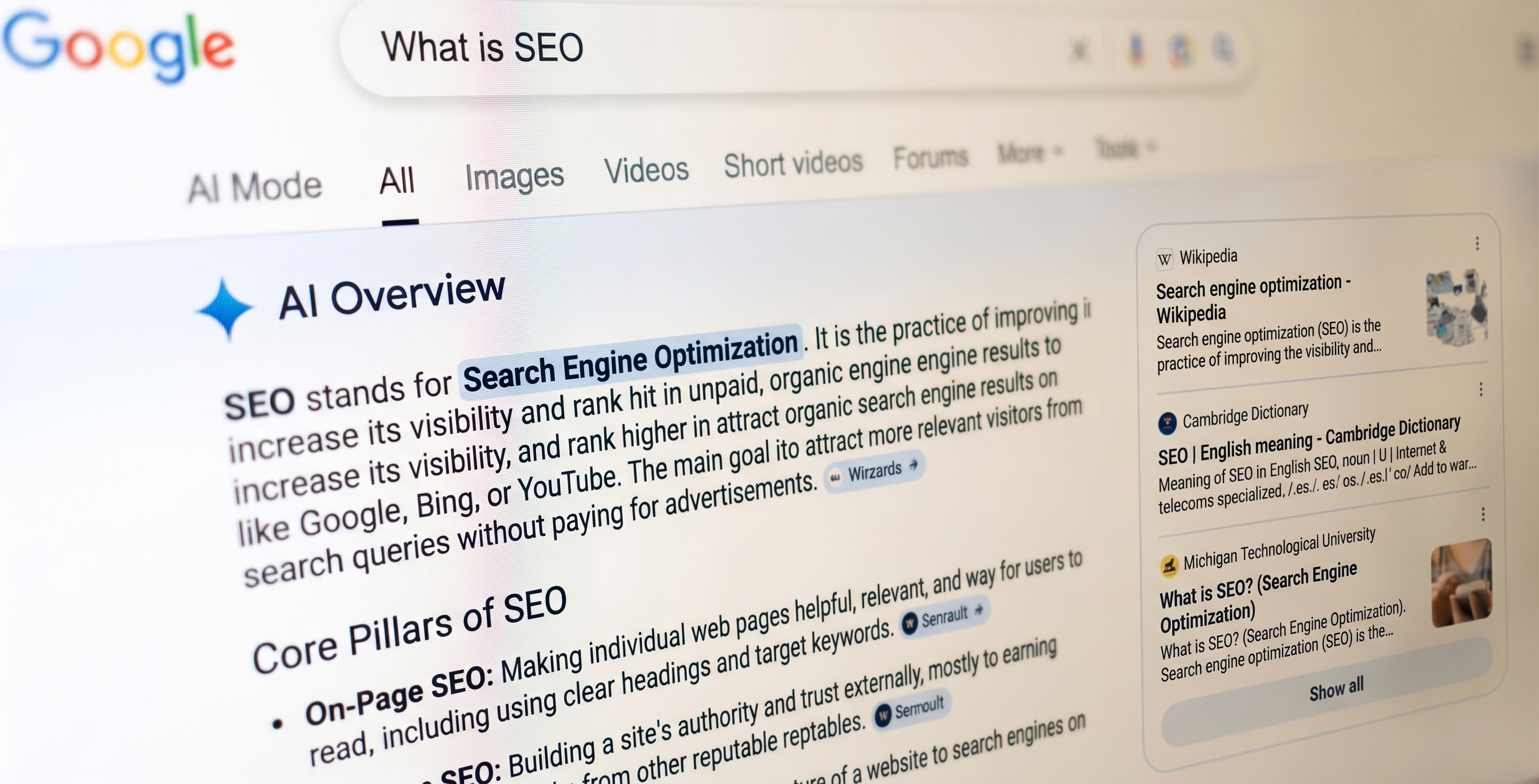
Traditional SEO ranking logic simply doesn't map onto how AI Overviews work. That's the core point worth getting straight before anything else.
When someone types a question, Google breaks it down into several related sub-queries — what Google calls a "query fan-out" — retrieves information for each one, and stitches the results together into a cited, composite answer.
Three consequences follow directly:
- You're competing at the passage level, not the page level. Whether your content gets used has nothing to do with where your page ranks overall — it comes down to whether one specific passage gets pulled out and cited.
- Visibility across sub-queries matters just as much as visibility for the main query. Behind every question a user types, there are usually several implied follow-up questions, and each one is its own retrieval opportunity.
- There's a cap on answer length, so a longer page isn't an advantage. Writing more doesn't improve your odds of being picked — we'll come back to why in a moment.
The practical consequence: the thing that has to be good is a block, not a page. A strong page with no cleanly liftable block loses to a weaker page that has one.
Step 0: Do you need to rank in regular search first?

Two checks come before any rewriting, and either one can invalidate everything downstream.
Can a crawler reach and parse the content? Google's stated requirement is that a page be indexed and eligible to be shown in Search with a snippet — that is the eligibility gate for being cited at all. Content that arrives via JavaScript, sits behind a consent gate, or is served differently to unfamiliar user agents may simply not be available to the pipeline, however well it is written. Fetch your own page with a plain request and no cookies, then read what comes back. If the answer isn't in the initial HTML, fix that before touching a sentence.
Are you in the conventional pool for this query at all? The pool an answer is assembled from is drawn from Google's index, and on repeated observation it is weighted toward pages already performing for the query and its close variants. Google has not published how strongly, so treat this as a check rather than a score: look at whether you appear for the query or its variants at all. If nothing on your site does, passage-level polish is premature. The realistic move for a low-authority site is to pick queries where the pool is shallow — few results, no dominant institutional source — rather than to out-write a page that outranks you twentyfold.
To be blunt about the order: passage optimisation improves your odds of being selected from the pool. It does not put you in the pool.
There's a genuine opening on the other side of this. Once you are in the pool, selection weights passage quality far more heavily than ranking does — which is real room for a smaller site. You are not trying to out-muscle a major publisher on domain authority. You are trying to write one block that answers a single sub-question more cleanly than theirs does, and that survives being lifted out without repair.
Six passage-level edits that actually move the needle
Everything below is worked backwards from the mechanism above. We're deliberately not giving you a word count or a ranking threshold to hit — nobody has published that number. We're not going to invent one just to sound more confident than the data actually allows.
Google's documentation on AI features states that there are "no additional requirements to appear in AI Overviews or AI Mode, nor other special optimizations necessary," and that a page needs only to be indexed and eligible to be shown with a snippet.
That statement is compatible with what follows, and it is worth saying why rather than quietly working around it.
What that rules out is content reshaped for a machine at the reader's expense: one-sentence paragraphs, thirty question headings on a page, each answered shallowly. That does not work, and it is not what the six edits below ask for. What the edits ask for is narrower — that a passage carries its own subject, conditions and numbers, so it stays true when read on its own. That requirement isn't a trick aimed at a retrieval step; it is what any reader landing mid-page from a search result also needs, and it is the reason the same edits improve the page for people.
So: no special markup, no chunking for its own sake, and a ceiling on question headings. Write blocks that stand up alone because that is what makes them correct.
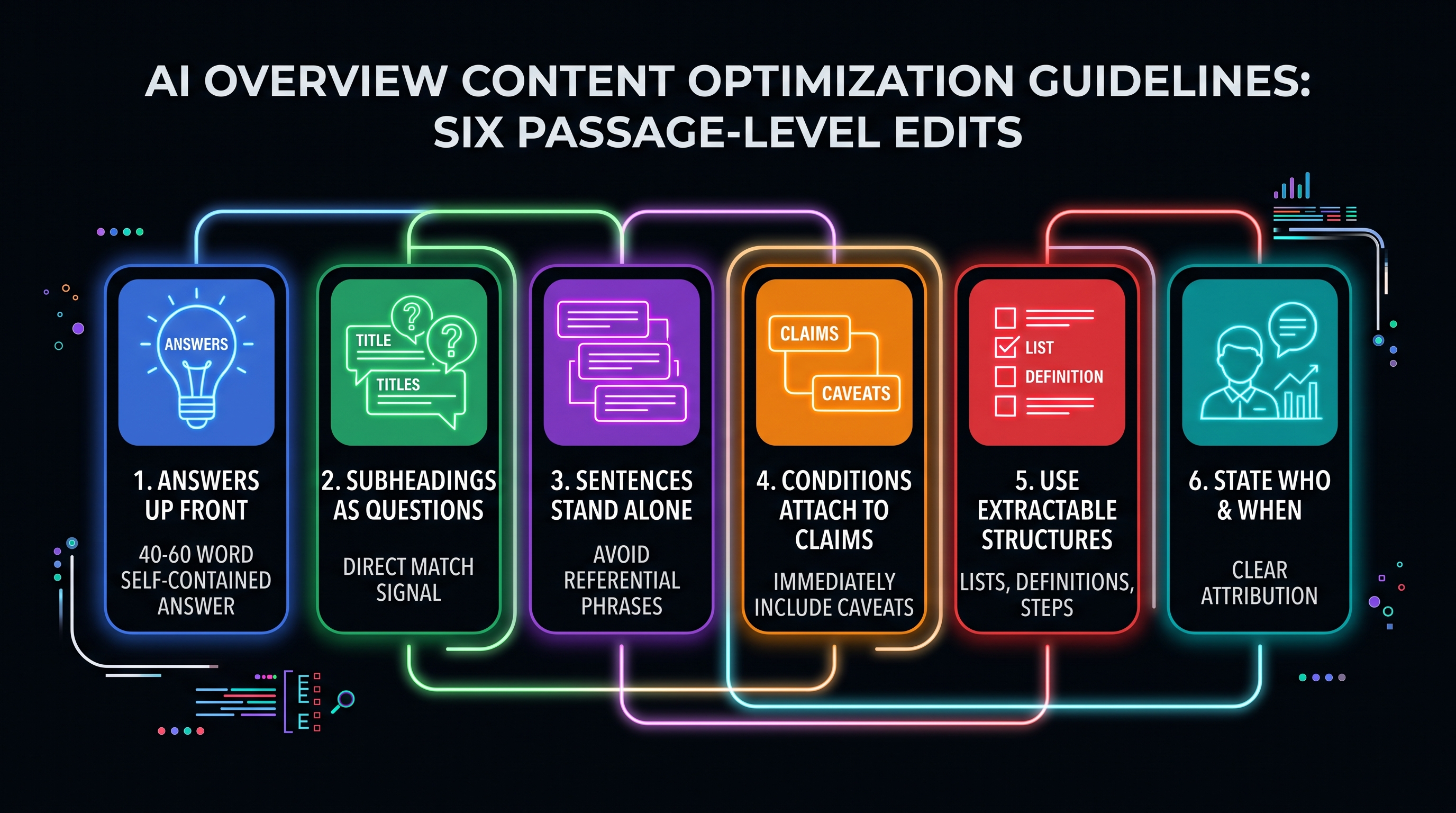
1. Front-load a 40–60 word self-contained answer
The opening of a section should answer the question on its own, without relying on the content that follows.
- Before: "There are a lot of different perspectives on this, and we think it's worth looking at it from a few angles..."
- After: "Of the 60 Hong Kong keywords we tested in August 2026, 41 returned an AI Overview — 68.3% counting the five with no usable SERP record as non-triggering, or 74.5% of the 55 we could verify."
That's our working range, not a published threshold.
2. Write your subheadings as questions — but cap the number
Phrase the heading the way a person would ask it, not as a keyword string. "How long does GEO take to show results?" beats "GEO Timeline." The heading is part of what gets scored against the query, and a bare noun phrase throws that away.
Cap the number, though. A page of thirty question headings reads as a scrape and answers each one shallowly — that's the version readers bounce off, not the version that gets cited. Use the question form where the section genuinely answers a question someone asks, and leave the rest as they are.
3. Write sentences that survive being cut loose
Assume every sentence might be lifted out on its own and dropped into an answer box with no surrounding context. If a sentence relies on referential phrases like "as mentioned above" or "following on from the previous point," it can't stand alone — and it won't get picked.
- Before: "As noted earlier, the same logic applies here."
- After: "AI Overview answers have a length cap, which means total page length isn't what determines extraction probability."
4. Keep the condition attached to the claim, not three paragraphs later
A lot of content states a conclusion up front and buries the caveat three paragraphs down. AI Overviews extract fragments — and fragments drop caveats. The result is a misleading summary that technically came from your own copy.
- Before: "AI Overview trigger rates are rising. [three paragraphs later] Of course, this figure may not apply across every industry."
- After: "AI Overview trigger rates are rising, but this applies specifically to informational queries — transactional queries show a noticeably different pattern."
5. Use structures that lift cleanly
Lists, clear definitions, numbered steps — these formats are built to be extracted. Google's systems can identify and pull a well-structured block far more reliably than a dense paragraph of prose.
6. Say who's saying it, and when — and make the markup agree
Name the organisation and the date behind every figure. "Industry consensus suggests" is not attribution; "our 60-keyword Hong Kong sample, August 2026" is. This weighs most in health, legal and financial topics, where an unsourced number is a reason to skip the page entirely.
Then make the structured data say the same thing the page says: BlogPosting with a real author entity and an accurate datePublished, FAQPage whose answers match the visible text word for word, Organization linked by sameAs to profiles that actually exist. Markup that claims something the page doesn't say is a liability rather than a signal — and note that Google's own position is that no markup is required to appear in AI Overviews at all. Schema helps because it removes ambiguity about who is asserting what, not because it unlocks a feature.
Should you write broader pages or shorter ones?

If structure matters this much, wouldn't a longer, more comprehensive page cover more ground?
Breadth and length operate at completely different levels — conflating them is where most of this goes wrong.
- Breadth means answering more distinct questions — increasing the number of "entry points" that could be extracted.
- Length means packing more into a single passage — which dilutes the exact block that needs to stand on its own.
How often do AI Overviews trigger in Hong Kong?

We tested 60 Hong Kong keywords across eight industries in August 2026. 41 of them returned an AI Overview — 68.3% of all 60 tested, or 74.5% of the 55 for which we could verify a SERP record. We report both ends of that range rather than picking the flattering one.
Three things in the data are worth more than the headline number.
A local pack does not protect you. 12 of the 17 keywords that returned a local pack returned an AI Overview as well. The five exceptions were all direct "find me a provider" queries — searchers who want a business, not an explanation. So the useful question is not whether a local pack appears, but which of those two kinds of query you are targeting. Appearing in Google Maps does not guarantee a visit to your site: a searcher can take what they need from the generated answer sitting above the pack.
Sector variance was wider than our headline range. Marketing and SEO terms triggered 62.5% of the time; cross-industry consumer terms 79.5%. All five insurance keywords we tested triggered, while property terms were the weakest set in our sample. With five keywords per sector, those are pointers for where to look rather than sector rates — which is the actual takeaway: the average is the least useful number here.
English and Chinese queries are two measurements, not one. Chinese-language queries triggered more often than English ones in our sample — 29 of 36 with usable data, against 12 of 19 — but our Chinese set skewed consumer and our English set skewed B2B, so at n=60 we cannot separate language from topic. Treat that as an unresolved observation, not a finding.
This is our sample, not your market. Check your own categories before applying any of these numbers to them.
When should you not chase an AI Overview?

Not every AI Overview is worth chasing. In some cases, pursuing AI Overview visibility simply isn't the best use of resources:
- Queries about the platform's own products — something like "what is an AI Overview" already has Google's own documentation dominating the results. Outside content rarely breaks through.
- Regulatory or legal definition queries — where a precise legal definition is involved, Google tends to defer to official or institutional sources.
- Medical or legal facts backed by institutional authority — specific drug dosages, statutory interpretations, and similar content where Google leans toward established, credible institutions.
Rather than forcing your way into these, a better use of the same effort is targeting the operational question that comes right after — the thing a practitioner asks once they already know the definition and want to know what to actually do about it. There's far less competition there, and it's usually closer to what your actual prospects are searching for anyway.
How do you tell whether it worked?
The most common mistake in AI Overview optimization is assuming a change worked simply because you made it. Without a way to verify, you're just guessing. At minimum, we'd suggest:
- A fixed tracking list. Lock in a set of keywords and don't let the scope drift — otherwise there's nothing consistent to compare against.
- A recorded baseline. Capture your current trigger and citation status before you make any changes.
- An understanding of normal noise. Search results fluctuate naturally. Know the normal range of variation before you start attributing every shift to your own work.
- Consistent measurement conditions. Numbers pulled from different tools, time periods, or location settings aren't comparable to each other — don't treat them as if they are.
Where The Citation Loop puts this

The checks and edits above map onto four stages we run as a loop:
- Generative Visibility Audit — the two Step 0 checks, plus the baseline and noise floor.
- Knowledge Architecture — edits 1 through 5. Most of the work sits here.
- Schema & E-E-A-T Injection — edit 6, and making the markup agree with the visible page.
- Citation Monitoring — re-run the same protocol on the same list, and feed what moved back into stage 2.
It is a loop rather than a checklist because the surface moves underneath you: a passage cited in June can drop out in August with nobody touching the page.
If you want to know whether your pages are in the extractable pool at all, that is what a free SEO audit covers — the Step 0 checks above, run against your own site before any passage work.
Where this approach hits its limits
Two limits, stated precisely, because the imprecise versions are what get sold.
- We don't know what organic ranking position gets you into the AI Overview candidate pool. Nobody has published that number, and we're not going to invent one just to sound more confident than the data allows. Step 0 is a check, not a score.
- How long any given optimization holds is genuinely uncertain. Google's extraction logic shifts over time on its own — this is why we call it a Loop rather than a Project. This isn't something you do once and walk away from. It needs to be watched and adjusted continuously.
FAQ
1. How do you get cited in AI Overviews?
You get a passage extracted rather than a page ranked. First confirm the page is in the initial HTML, crawlable, and already appearing for the query or its close variants — Google requires a page to be indexed and snippet-eligible before it can be cited at all. Then write each section so its opening 40–60 words answer that section's question on their own, with the subject, conditions and figures inside the sentence rather than in the paragraph before it.
2. Do I need to rank on page one to appear in an AI Overview?
There's no published threshold that answers this cleanly. What we can say is that regular visibility is a prerequisite, not the whole story — once you're in the pool, selection comes down more to passage structure and quality than exact ranking position.
3. How long does it take to appear in an AI Overview?
There's no fixed timeline. It depends on how often the query triggers an Overview at all, how frequently your content gets updated, and Google's own recrawl and evaluation cycle. This is exactly why we recommend tracking over time rather than expecting a one-off result.
4. Are AI Overviews the same as featured snippets?
No. A featured snippet typically pulls from a single source and a single passage. An AI Overview assembles fragments from multiple sources into one composite answer with several citations — the mechanics and the competition are different.
References: