
How to Choose an AI SEO Agency: 7 Questions to Ask in 2026
The quickest way to assess an AI SEO agency is not to start by asking, “Do you offer GEO?” Instead, ask: How do you measure my AI visibility today, what is the baseline, and what exactly are you planning to improve next? An agency that cannot answer those three questions in a pitch will not be able to prove later that it caused anything.
This guide is for marketing decision-makers in Hong Kong evaluating an ongoing AI SEO, GEO or AEO retainer across English and Traditional Chinese search. Platform and reporting details reflect official documentation as at 31 August 2026.
It covers seven questions to ask before appointing an agency, two proof points that can look impressive but tell you very little, and four things you should understand clearly by the end of a pitch.
Terms such as AI SEO, GEO and answer engine optimization (AEO) are still not fully standardised across the market, and different agencies use them to mean different things. If you want to separate these concepts first, see GEO vs SEO vs Answer Engine Optimization (AEO): What’s the Difference?
Google also states that existing SEO fundamentals and Search technical requirements continue to apply to AI Overviews and AI Mode. Google does not require a separate AI-specific technical framework, special writing format, artificially fragmented content or AI-specific markup for its generative AI Search features.
So whether an agency uses the latest AI SEO acronym is not the most important thing to compare. What matters more is whether it has a method that can be clearly explained, properly executed and measured again over time. If you are still defining the scope of the service itself, see how our AI SEO services approach search visibility, content and measurement.
Why Is It Harder to Compare AI SEO Agencies Directly Right Now?
Traditional SEO already has more established and familiar ways to measure performance, such as:
- organic impressions
- rankings
- clicks
- conversions
AI Search measurement introduces more variables in practice, including:
- AI platform
- prompt set
- location
- language
- testing period
- response variation across repeated tests
- different tools using different definitions or calculations for citations, mentions and visibility
That means two agencies can report an “AI Visibility Score” without actually measuring the same thing. A score is only comparable when the underlying platforms, prompts, market, testing period and calculation method are also comparable.

Google’s 2026 guidance on third-party SEO tools and services notes that third-party tools do not have access to Google’s internal ranking data and cannot guarantee Search performance. Any predictions or proprietary scores they provide therefore remain third-party interpretations rather than Google ranking data.
This does not make third-party AI visibility tools useless. It means the methodology matters more than the headline score.
So when comparing AI SEO agencies, do not only ask:
“What is the score?”
Ask:
“How was this score measured?”
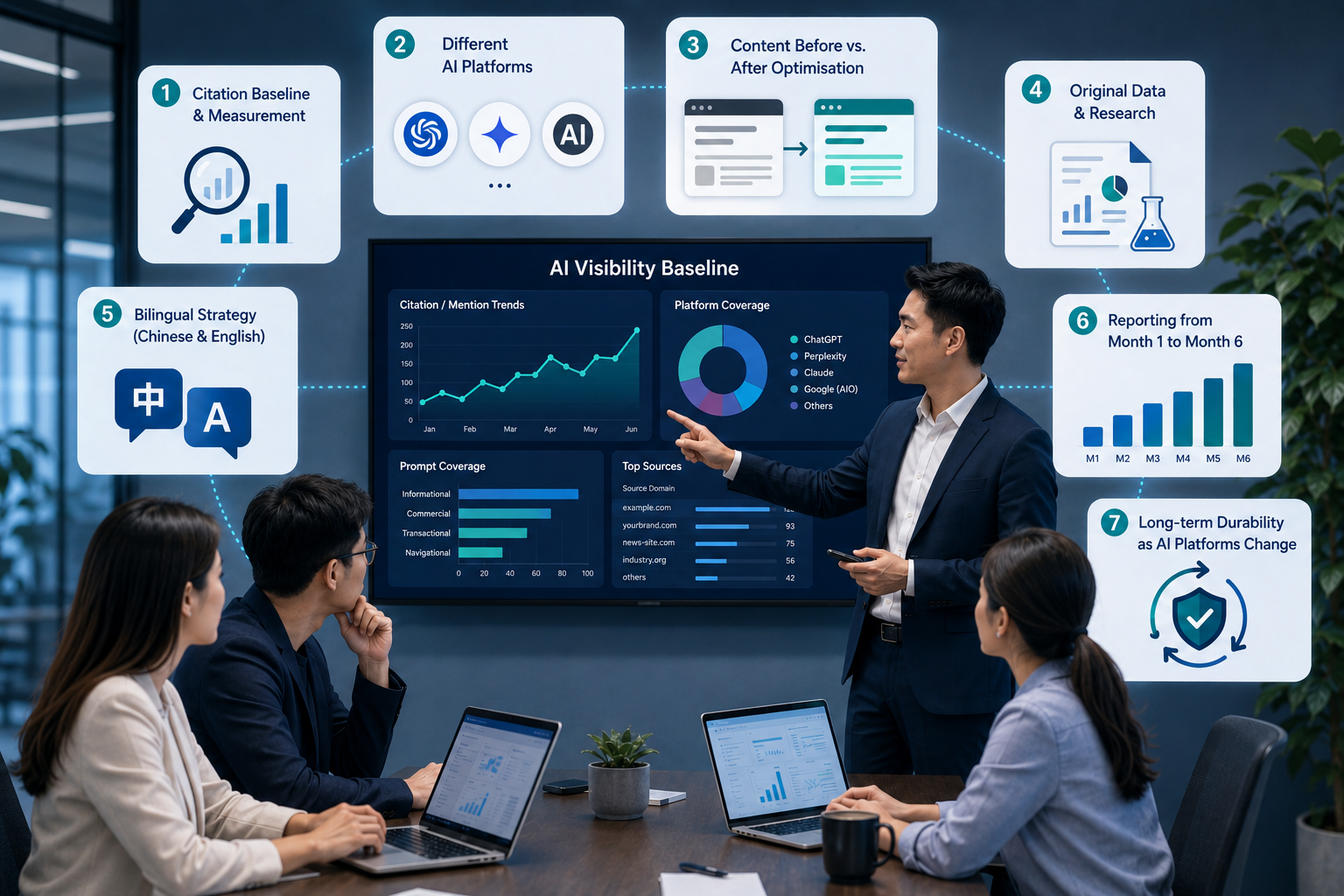
7 Questions Worth Asking an AI SEO Agency
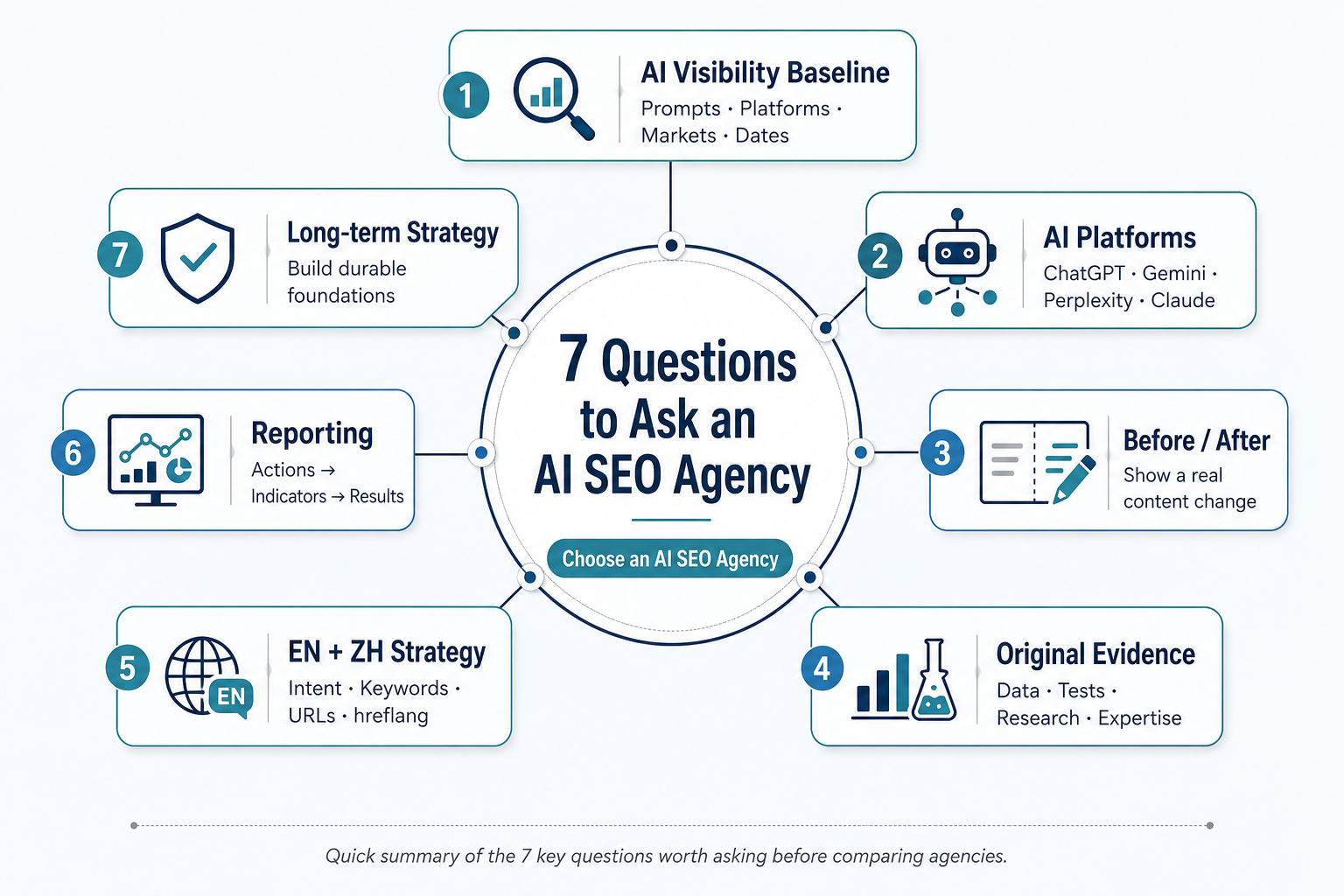
The seven questions, in the order they are worth asking:
- How to check your AI visibility baseline before signing
- How AI platforms differ: crawlers, search bots and retrieval systems
- What a real before-and-after content rewrite looks like
- What original research an AI SEO agency should produce for you
- Handling English and Traditional Chinese SEO in Hong Kong
- What AI SEO reporting should show in months one to six
- How durable is AI SEO work when AI Overviews change?
1. How to Check Your AI Visibility Baseline Before Signing
Ask:
“What is our AI visibility baseline today, and how do you measure it?”
The first question should not be:
“How much can you increase it?”
Start with:
“Where are we now?”
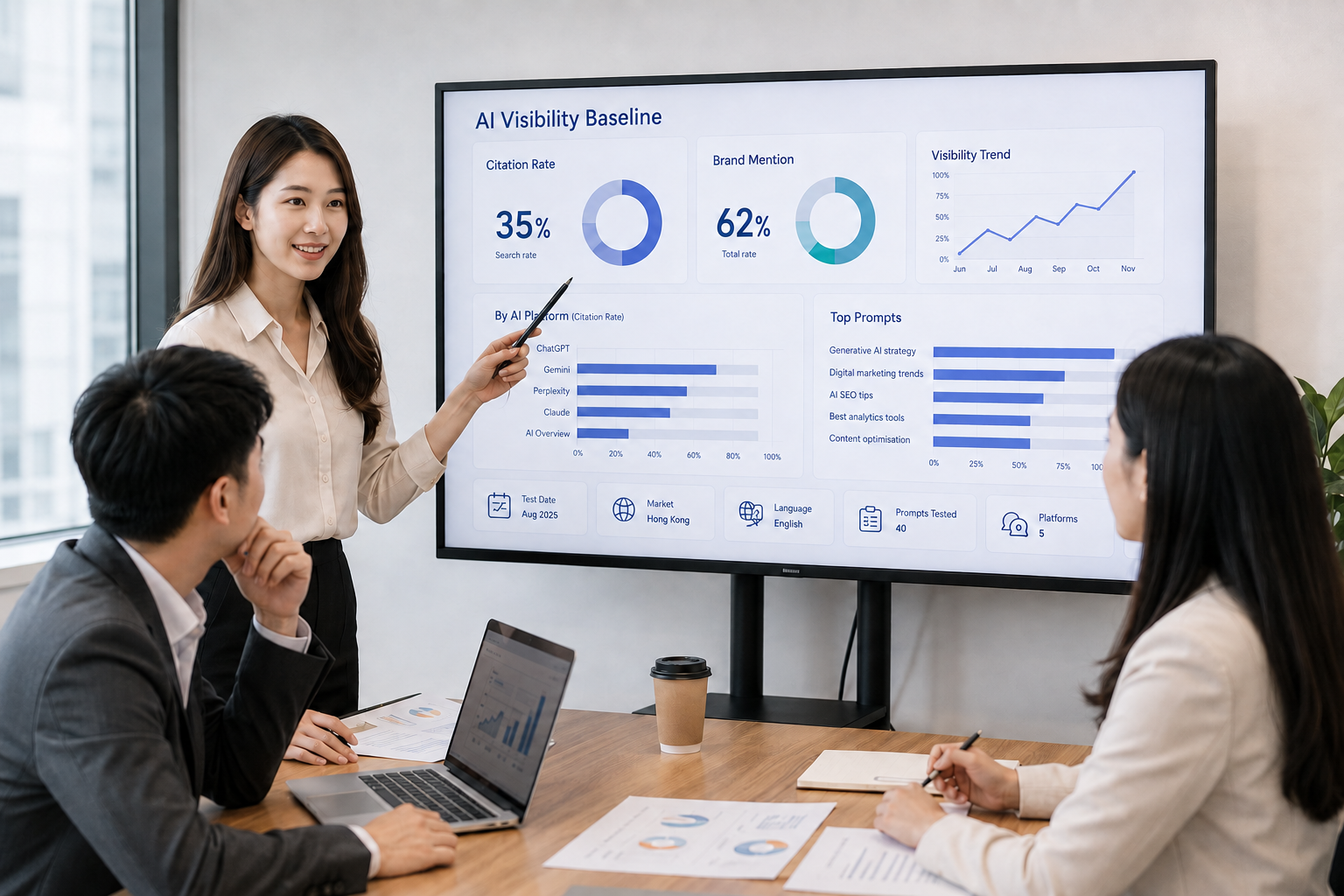
A useful baseline should explain:
- which prompts are being tested
- which AI platforms are being tested
- the testing date
- which market is being measured
- whether the test is in English or Traditional Chinese
- whether prompts are tested once or multiple times
- what counts as a citation
- what counts only as a brand mention
Different AI visibility tools may use different prompt sets, platforms, testing methods and calculation methods. That means the same citation rate can represent very different underlying tests.
So if you see a “35% citation rate”, do not focus only on the 35%. Ask:
“Which prompts, platforms, markets and testing period were used to calculate this 35%?”
A useful baseline should also track citation rate, share of voice and prominence across a fixed set of prompts, platforms and dates so that before-and-after comparisons are more meaningful.
A more reassuring answer might sound like:
“This baseline was measured between 1 and 7 August 2026, using a fixed set of 40 commercial prompts in the Hong Kong market. Each AI platform is measured separately, each prompt is run three times, and citations and brand mentions are tracked separately.”
A more concerning answer would be:
“We’ll work out how to measure it after you sign.”
A baseline should be established before major optimisation work begins. If the starting point is unclear, later improvements will be much harder to interpret fairly. An SEO and AI Search audit can help establish that reference point before major optimisation work begins.
2. How AI Platforms Differ: Crawlers, Search Bots and Retrieval Systems
Ask:
“Which AI platforms do you actually work on, and what is different about them?”
Generative engine optimization (GEO) describes work aimed at getting a brand named or cited inside an AI-generated answer, whichever assistant or search feature produces it. That definition is broad enough to cover very different products, which is why the next question matters.
ChatGPT, Gemini, Claude and Perplexity are AI assistants, but they do not all discover and retrieve web content in the same way. Google also operates AI Overviews and AI Mode inside Google Search, which should not be treated as interchangeable with the standalone Gemini assistant.
ChatGPT can use web search and surface links to relevant sources, while Claude and Perplexity also use their own web-search or retrieval mechanisms. Google AI Overviews and AI Mode, by contrast, are generative AI features within Google Search and draw on Google’s existing Search systems and web index.
That distinction matters when an AI SEO agency talks about “optimising for AI”. The agency should be able to explain which product it means, how that product discovers or retrieves web content, and what role crawlers, search bots, user-triggered retrieval or existing search indexes play.
If an agency simply says:
“ChatGPT, Gemini and Perplexity are all GEO. The approach is basically the same.”
That is not enough information.
Different AI products already have publicly documented differences in how they access and retrieve web content.
| Product / Search experience | Organisation | Web discovery / retrieval context |
| ChatGPT | OpenAI | Can use web search; OAI-SearchBot helps surface websites in ChatGPT Search |
| Gemini | Google AI assistant; should be distinguished from AI features inside Google Search | |
| Claude | Anthropic | Can use web search and retrieve current web content |
| Perplexity | Perplexity | Search-oriented AI assistant with its own crawler and user-requested retrieval mechanisms |
| AI Overviews / AI Mode | Google Search | Generative AI features within Google Search, drawing on Google Search systems and index |
The underlying bots and user agents also serve different purposes:
| Organisation | Bot / User Agent | Role |
| OpenAI | OAI-SearchBot | Helps surface websites in ChatGPT Search |
| OpenAI | GPTBot | Crawls content that may be used to train OpenAI's generative AI foundation models; blocking it in robots.txt is how a site opts out of that use |
| OpenAI | ChatGPT-User | Used for some user-triggered page access; not used to determine whether content can appear in ChatGPT Search |
| Perplexity | PerplexityBot | Crawls content to surface and link websites in Perplexity search results |
| Perplexity | Perplexity-User | Retrieves pages in response to user requests |
| Anthropic | ClaudeBot | Collects public web content that may contribute to model development |
| Anthropic | Claude-User | Retrieves content in response to user-directed requests |
| Anthropic | Claude-SearchBot | Accesses web content for search-related retrieval |
That distinction has a practical consequence. OpenAI’s guidance for publishers and developers identifies OAI-SearchBot as the crawler relevant to website discovery and inclusion in ChatGPT Search. An agency recommending bot-level blocking should therefore be able to explain which user agent affects which surface.
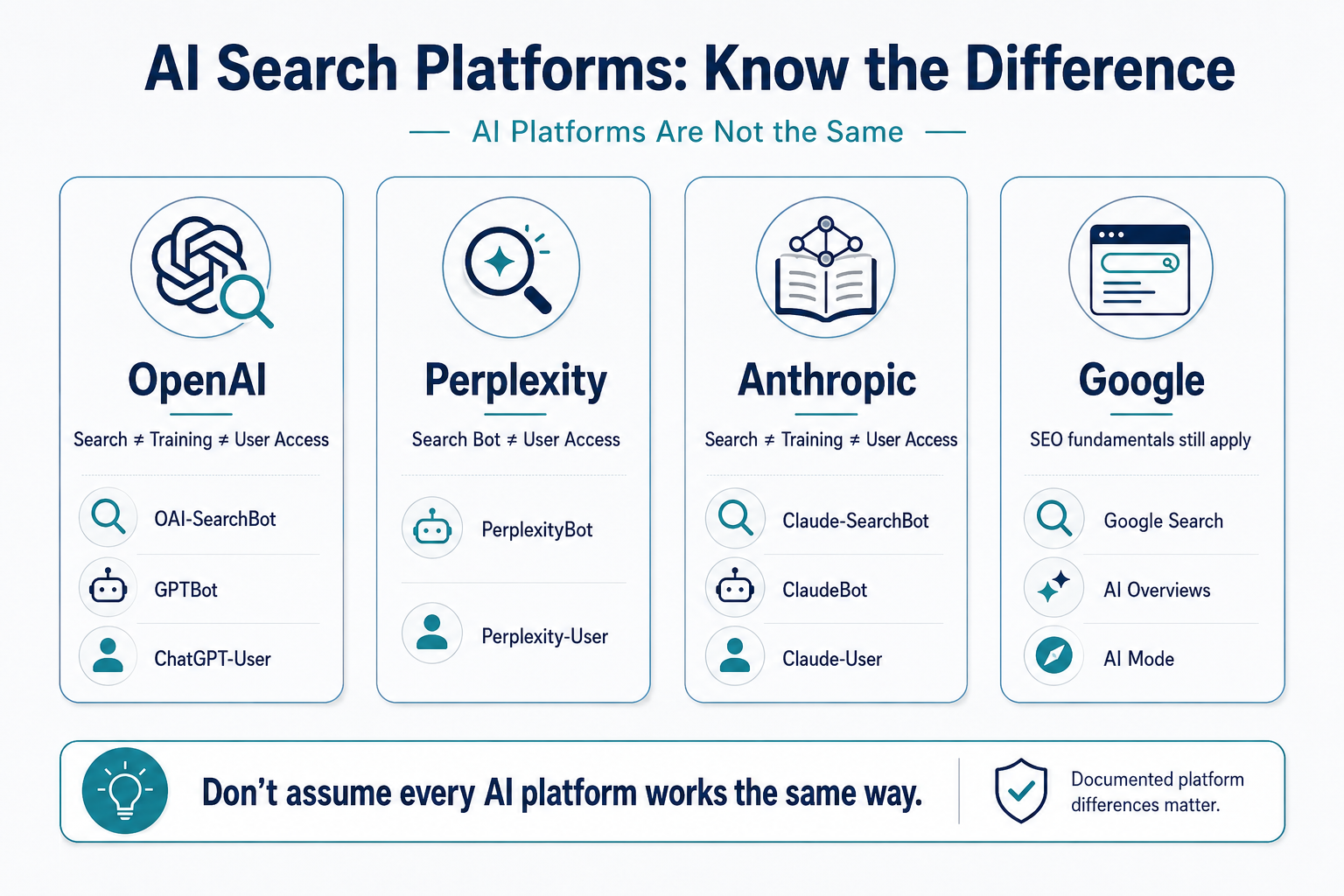
OpenAI distinguishes OAI-SearchBot, GPTBot and ChatGPT-User, including separate roles for search discovery, model-related crawling and user-triggered page access.
Perplexity similarly distinguishes PerplexityBot and Perplexity-User: PerplexityBot is used to surface and link websites in search results, while Perplexity-User may access pages in response to a user request.
Anthropic also distinguishes ClaudeBot, Claude-User and Claude-SearchBot for model-development crawling, user-directed retrieval and search-related access respectively.
Google states that existing SEO fundamentals and Search technical requirements continue to apply to AI Overviews and AI Mode. Google also explains that these generative AI features rely on its existing Search ranking systems and Search index.
An AI SEO agency does not need to claim that it knows every undisclosed ranking factor used by every platform. It should, however, be able to separate two things clearly:
Which information is officially documented by the platform, and which conclusions come from the agency’s own testing.
If every platform is explained with the same line:
“This is our method for cracking the AI algorithm.”
Ask for the evidence, testing method and platform-specific assumptions behind that claim.
3. What a Real Before-and-After Content Rewrite Looks Like
Ask:
“Show me a piece of content you changed and explain why you changed it.”
Do not rely only on a whole-site case study. Ask the agency to show you a real:
Before → After
Then ask why each change was made.
Reasonable reasons for changing content might include:
- the original copy did not answer the question directly
- figures or claims had no supporting source
- important conditions or limitations were missing
- one paragraph mixed several search intents
- the heading and the answer did not match
- table labels were unclear
- repeated information buried the main answer
For example, the original copy might say:
“As AI Search continues to grow rapidly, more businesses are starting to pay attention to GEO…”
A revised version might answer the underlying question more directly:
“GEO focuses on whether a brand or website is mentioned or cited in generative AI answers, and how that visibility can be measured.”
A before-and-after example does not prove that the rewrite improved AI visibility. What it can show is whether the agency identified a specific content, evidence or readability problem and made a change intended to solve it.
A more concerning explanation would be:
“We added more AI keywords, so LLMs will like the content more.”
Google’s guidance on optimising for generative AI features in Search does not require a special AI writing format or near-identical versions of a page for every long-tail query or wording variation.
The stronger question is therefore:
“What did you change, what problem was it meant to solve, and how would you test whether the change helped?”
Not:
“Do you have an AI writing formula?”
4. What Original Research an AI SEO Agency Should Produce for You
Ask:
“What original data or research will you help us produce?”
If every company ends up publishing:
- What Is GEO?
- 5 Benefits of AI SEO
- 10 ChatGPT SEO Tips
- AI Search Trends You Need to Know in 2026
the content can quickly start to look the same.
This is where most LLM SEO content plans stop — at definitions anyone can restate from the first page of search results.
A more useful question is whether the agency can help the brand produce something competitors cannot easily recreate. For example:
- Can it use the company’s own first-party data?
- Can it run market tests or small-scale studies?
- Can it build benchmarks with a clear methodology?
- Can it identify processes or insights based on real company experience?
- Can it turn internal expert knowledge into genuinely useful content?
Google’s 2026 guidance on optimising for generative AI features in Search recommends creating unique, valuable and non-commodity content, including expert- and experience-led perspectives that go beyond common knowledge.
There is an important distinction:
Google does not say that first-party data guarantees an AI citation.
First-party data is useful because it can help a brand create evidence, observations and viewpoints that are harder to reproduce by simply summarising search results or rewriting information that already exists.
For example, our Hong Kong AI Overview study reviewed 60 Hong Kong search keywords using Ahrefs SERP snapshots collected between 1 June and 10 August 2026 to examine how often an AI Overview was recorded.
For this study, a trigger was counted when the Ahrefs SERP snapshot recorded an AI Overview for the keyword during the study period.
Five keywords did not have a usable SERP record during the study period, leaving 55 keywords with usable data. Among those 55 keywords, 41 recorded an AI Overview, giving an observed trigger rate of 74.5%.
If the five keywords without usable SERP data were instead counted as non-triggers, the rate would be 41 out of 60, or 68.3%.
The denominator changes the interpretation. That is why an agency should not present a benchmark without explaining the sample, date range, definition of a trigger, denominator and exclusion rules.
A percentage without that methodology can look more conclusive than the underlying data actually is. The keyword list and classification rules are available on request.
5. Handling English and Traditional Chinese SEO in Hong Kong
Ask:
“How will you handle Chinese and English content separately?”
This is particularly important in the Hong Kong market. A Traditional Chinese page should not simply follow this process:
English article → AI translation → publish
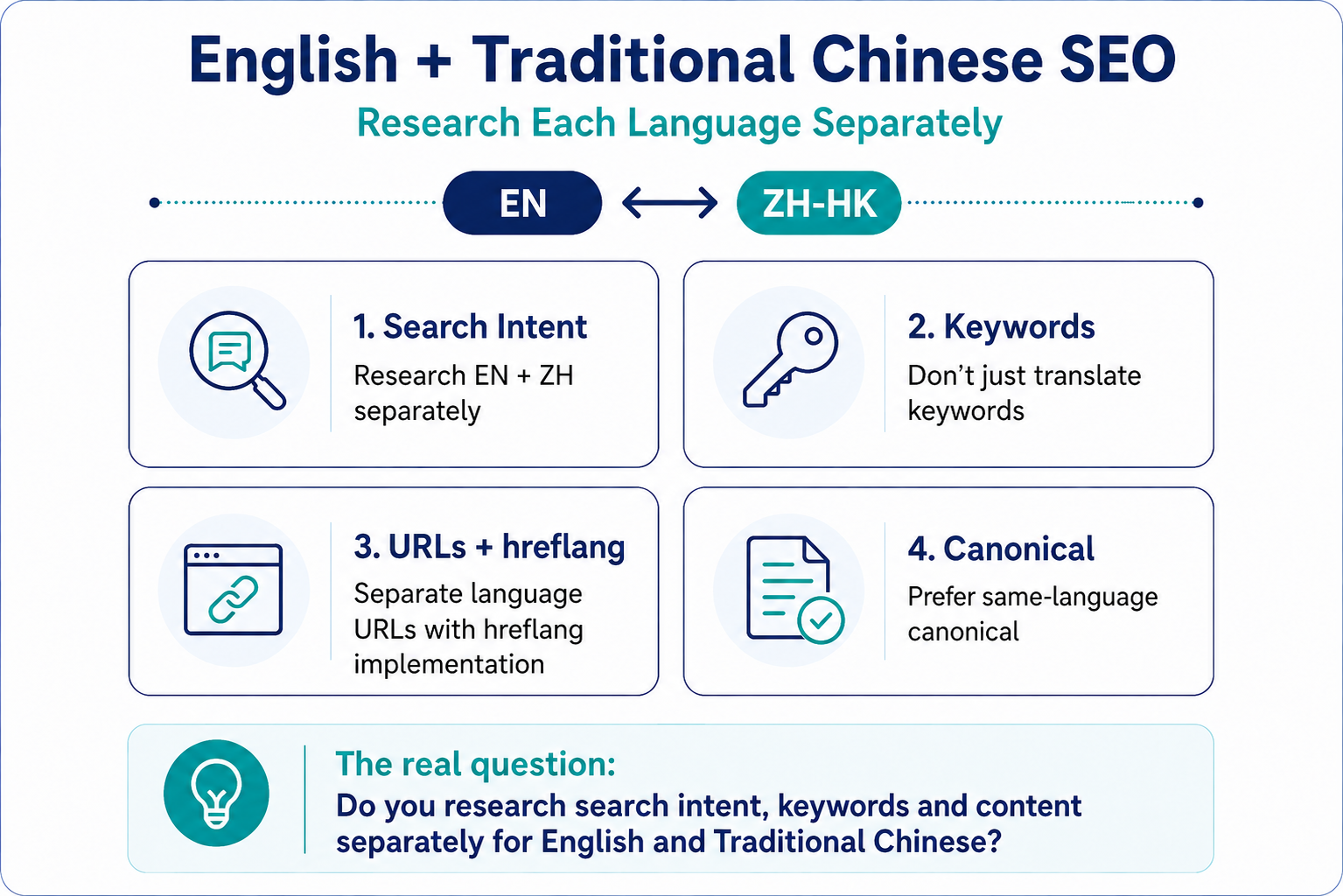
An AI SEO agency working in Hong Kong should at least be able to explain:
- the URL structure for English and Traditional Chinese pages
- whether both language versions target the same search intent
- whether keyword research is conducted separately for each language
- how hreflang is implemented
- whether each page points to the appropriate same-language canonical
- whether Hong Kong Traditional Chinese users search with terms that differ from a direct English translation
Google recommends using separate URLs for different language versions and using hreflang to help Google understand the relationship between language and regional variants.
When a site uses both hreflang and canonical tags, Google also recommends specifying a canonical page in the same language, or the best available substitute language when a same-language canonical does not exist.
But technical implementation is only part of the decision. The agency should also show that it understands how search behaviour can differ between English and Traditional Chinese users in Hong Kong.
So the real question is not:
“Do you provide translation services?”
It is:
“Do you research search intent, keywords and content separately for English and Traditional Chinese?”
Treating Chinese content as a translated copy of an English page can miss differences in wording, search intent and topic demand within a bilingual market.
Maxlytics’ Hong Kong AI Overview sample illustrates why those differences are worth measuring rather than assuming. Among keywords with usable SERP records, AI Overviews appeared for 29 of 36 Chinese-language keywords, or 80.6%, compared with 12 of 19 English-language keywords, or 63.2%.
That difference should be treated as an observation, not evidence that Chinese-language queries are inherently more likely to trigger AI Overviews.
The two groups were not directly comparable. The Chinese-language sample leaned more heavily towards consumer and commercial categories, while the English-language sample included more B2B marketing topics. Language and topic were therefore confounded.
A stronger comparison would require matched English and Traditional Chinese queries covering the same topics before drawing conclusions about the effect of language itself.
6. What AI SEO Reporting Should Show in Months One to Six
Ask:
“What will the reports show from month one to month six?”
Do not simply accept:
“SEO / GEO takes six months. Let’s review it after six months.”
Leads, revenue or overall organic growth may not show a clear change in the first month. But an AI SEO agency should still be able to explain:
Which leading indicators will be tracked before the final business results become clear?
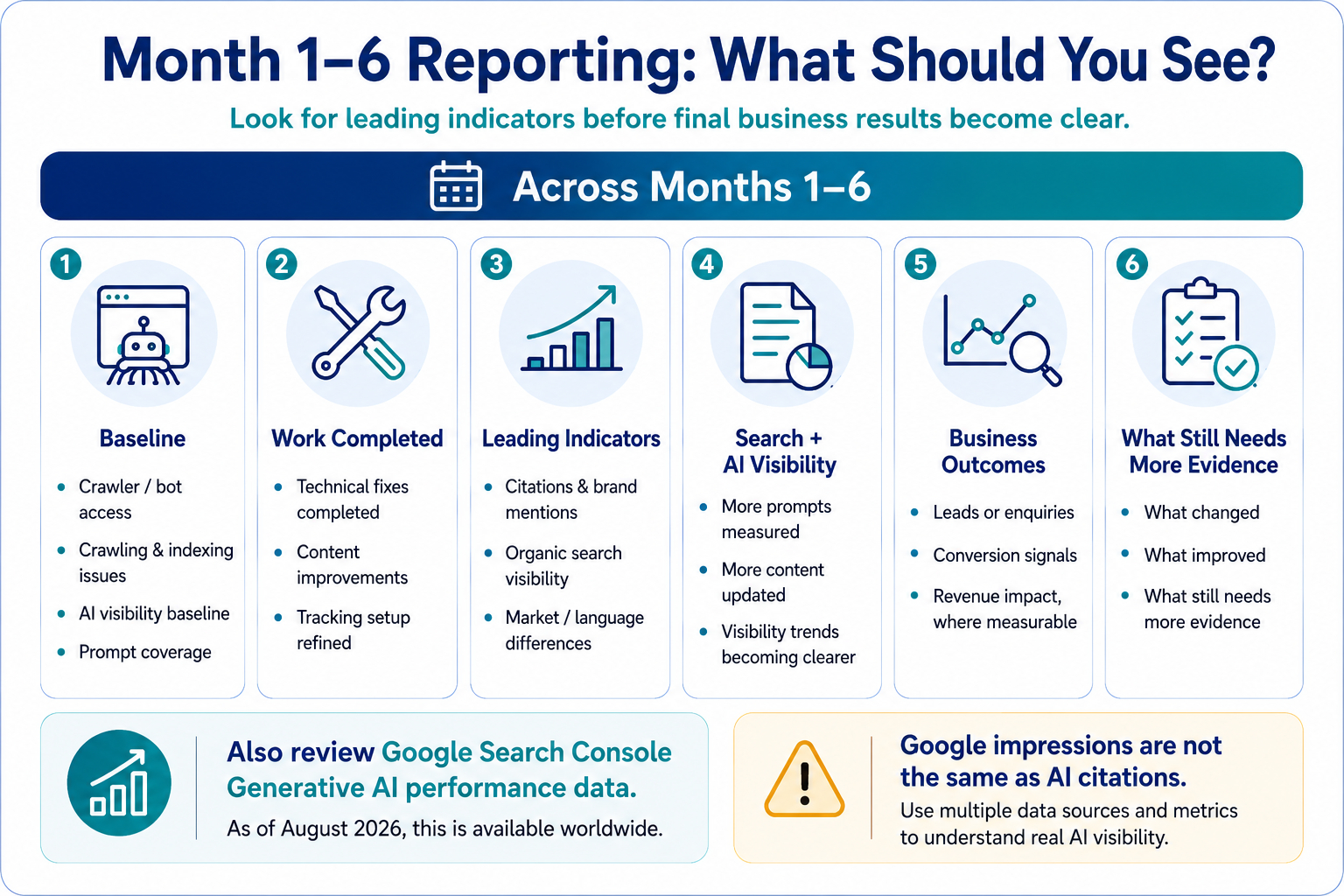
A useful report may include:
- crawler or bot access status
- crawling and indexing issues
- AI visibility baseline
- prompt coverage
- citations and brand mentions
- completed content improvements
- technical fixes
- organic search visibility
- visibility differences across markets and languages
- Google Search Generative AI performance data
- Bing Webmaster Tools AI Performance data
As of 31 August 2026, Google’s Search Generative AI performance reporting is available worldwide. The Search report focuses on impressions from generative AI features such as AI Overviews and AI Mode, with breakdowns by pages, countries, devices and dates.
Google’s reporting should not be treated as a citation tracker. An impression shows that a URL appeared in a Google generative AI Search experience; it does not show the same thing as a visible citation in another AI platform.
Bing Webmaster Tools provides a different type of first-party AI reporting. Its AI Performance report covers supported experiences including Microsoft Copilot, AI-generated summaries in Bing and selected partner integrations, and can show citation activity, cited pages and grouped grounding queries associated with those citations.
Bing is also previewing additional views for intents, topics, Citation Share and period-over-period comparison.
These metrics are not interchangeable:
| Reporting source | What it primarily measures | What it is useful for |
| Google Search Console | Generative AI impressions, pages, countries, devices and dates | Measuring visibility in Google AI Overviews and AI Mode |
| Bing Webmaster Tools | Citations, cited pages, grounding queries and citation trends | Understanding how content is referenced across Microsoft AI experiences |
| Third-party AI monitoring | Cross-platform prompts, mentions and citations | Comparing visibility across platforms such as ChatGPT and Perplexity |
A citation in Bing does not equal an impression in Google, and neither metric on its own represents total AI Search visibility.
A reasonable report therefore should not wait until month six just to tell you:
“Traffic went up / didn’t go up.”
It should help you understand:
What was done, which indicators changed, what those indicators actually measure, and which results still do not have enough evidence to support a conclusion.
7. How Durable Is AI SEO Work When AI Overviews Change?
Ask:
“If AI Overviews change again in six months, what happens to this work?”
AI search optimization is still a young discipline, and any agency presenting a fixed playbook is describing a surface that has already moved.
AI Search is still evolving, so a credible agency should not build its entire strategy on the assumption that current interfaces, reporting systems or platform behaviour will remain unchanged.
Areas that may change include:
- search experiences
- feature triggers
- crawler and access policies
- reporting capabilities
- measurement methodology
A tactic that works mainly because of one temporary AI interface, crawler behaviour or reporting gap may have a short shelf life. Durable AI SEO work should still make sense when the platform changes.
More durable foundations include:
- technical SEO
- crawlability and indexability
- genuinely useful content
- original data and supporting evidence
- clear brand and entity information
- repeatable measurement methodology
Google continues to state that established SEO fundamentals remain relevant to generative AI features in Search because AI Overviews and AI Mode build on Google’s existing ranking and quality systems. For a closer look at the Google side, see how pages actually get picked up by AI Overviews.
There is an important distinction:
These are reasonable long-term strategic principles. They are not a “GEO ranking framework” published by Google.
No tool vendor can guarantee this, for the reason set out earlier, and no agency should repeat a vendor’s guarantee as if it were its own.
A credible agency should therefore be able to explain which parts of its methodology come from documented platform guidance and which parts come from its own testing.
Ask the agency what it has changed its mind about in the last six months.
An agency that has never revised a benchmark, testing method or recommendation may not be demonstrating consistency; it may be showing that it has not been measuring closely enough.
So if someone promises:
“We guarantee you will stay number one for AI citations over the long term.”
Do not start by asking:
“What is your success rate?”
Ask:
“How do you define ‘number one’? Which platform? Which prompts? Which market? Which testing period? How often are you testing?”
A claim such as “number one for AI citations” has little meaning unless the agency defines the metric, platforms, prompts, market, testing period and comparison set. Without those conditions, there is no clear basis for the ranking.
Two Things That Look Professional but Do Not Tell You Much
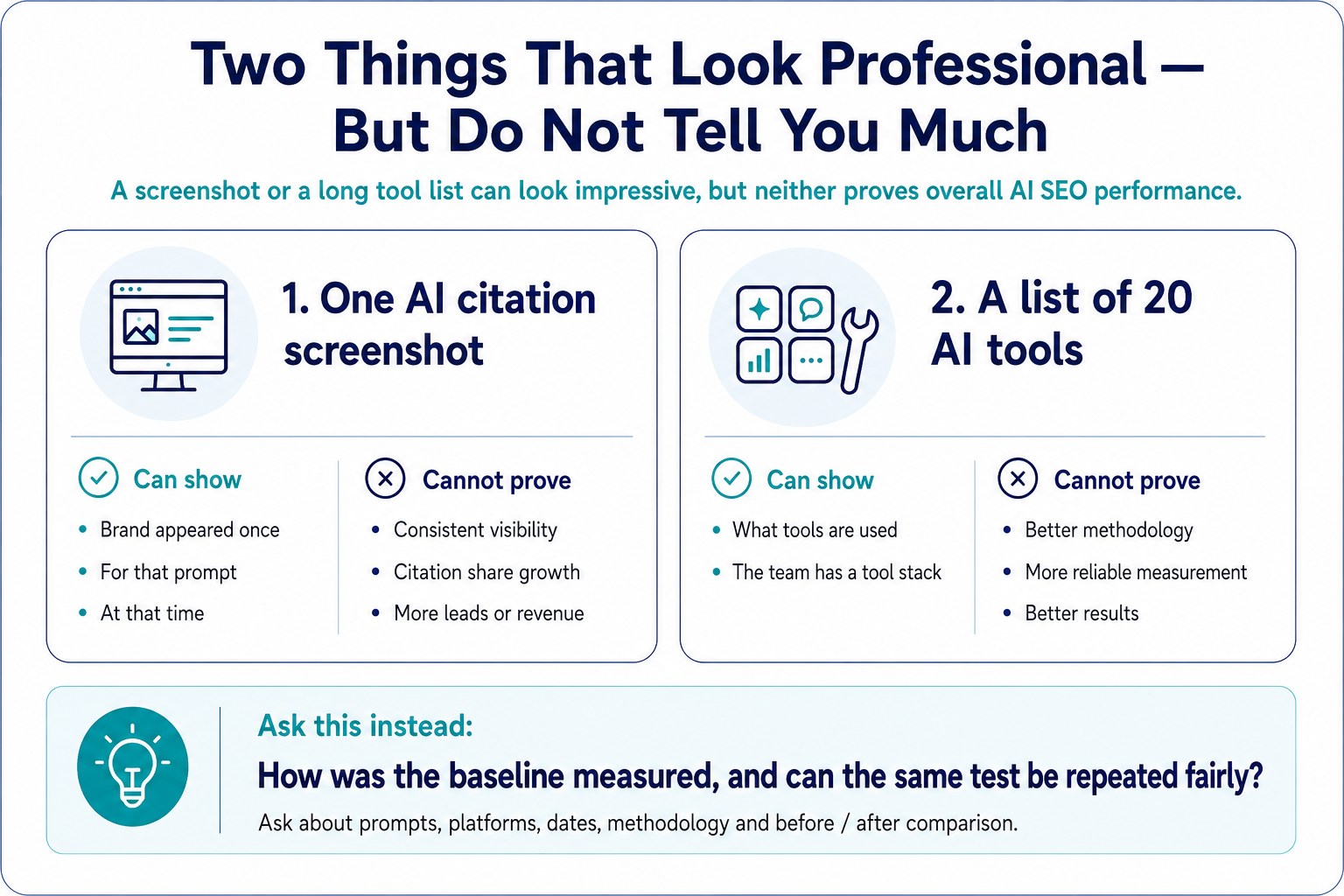
What a Single AI Citation Screenshot Can and Cannot Prove
A single AI citation screenshot proves that the brand appeared in one response, for one prompt, at one point in time.
It does not prove that:
- the brand will appear consistently
- other users will see the same response
- citation share is increasing
- competitor visibility is decreasing
- the result will generate more clicks, leads or revenue
A screenshot is evidence of an occurrence, not a measurement system.
If an agency shows you a screenshot and says, “We successfully got cited by ChatGPT”, ask:
- How many times was this prompt tested?
- How did related prompts perform?
- What was the baseline before optimisation?
- Was the result repeated using the same testing conditions?
The more useful question is not whether the brand appeared once. It is whether the result can be measured repeatedly using a consistent methodology and compared before and after the work.
What a List of 20 AI Tools Actually Tells You
A long tool list may look impressive in a pitch, but it mainly tells you which software the agency has access to.
Which tools an AI SEO agency licenses tells you about its software budget, not the quality of its methodology.
We would rather see one tool used to a written, repeatable protocol than twenty tools used ad hoc.
More useful questions include:
- What does each tool actually measure?
- What do you do when the same prompt produces different results across tools?
- Which data is first-party platform data, and which is a third-party estimate?
- Can the same baseline be tested again using the same settings?
- What decisions actually change because of the data?
The same principle applies when evaluating AI SEO software itself. These are also the questions worth asking when deciding what to ask an AI SEO tool vendor.
Every number in those dashboards is an estimate produced outside the platform being measured. That is not a reason to ignore them; it is a reason to ask which decisions an agency is willing to make on an estimate.
So do not only ask:
“How many tools do you use?”
Ask:
“How do you use these tools to make decisions?”
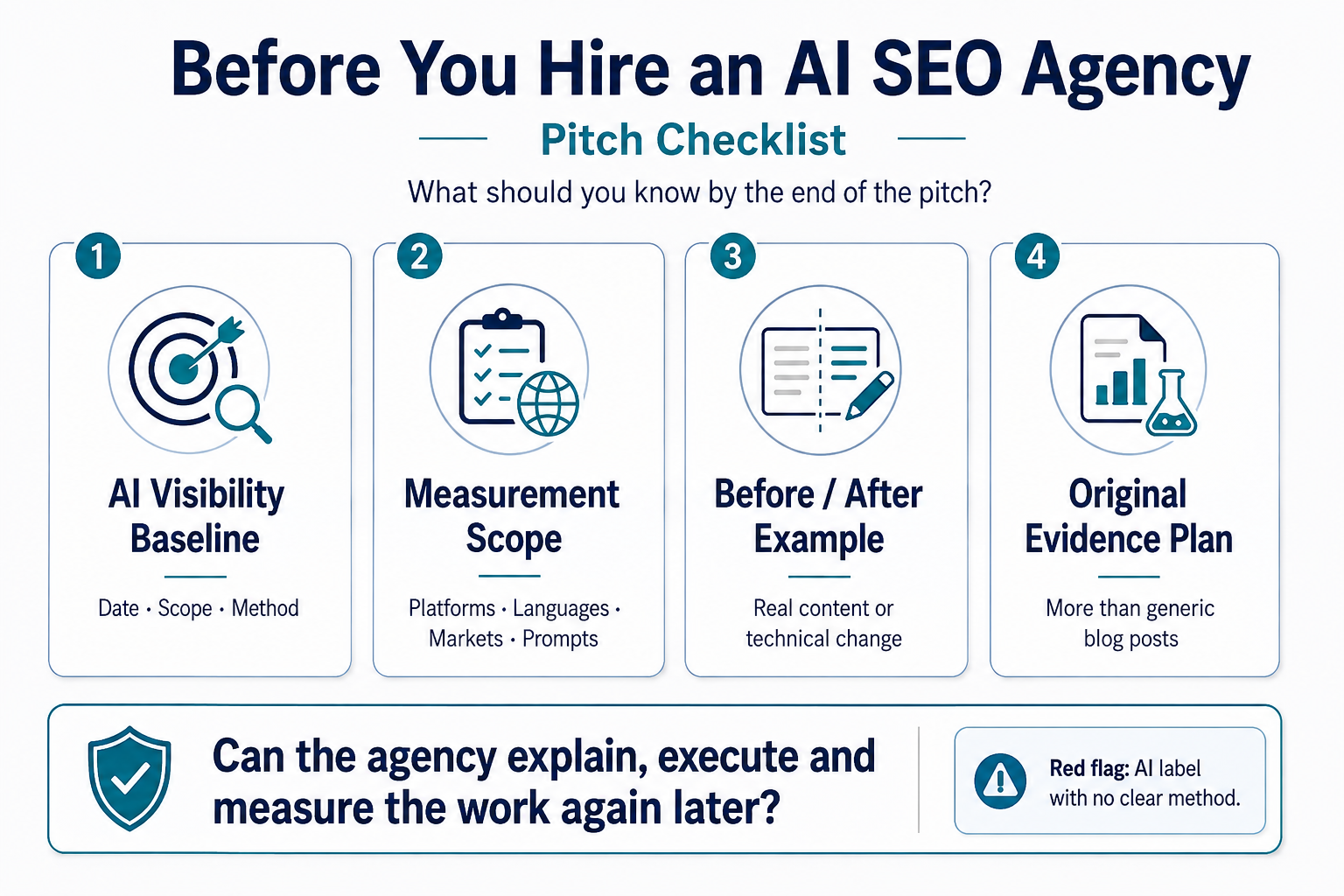
What Should You Know by the End of the Pitch?
You do not need to leave the pitch with a complete SEO strategy.
But you should at least understand these four things:
| You should know | What to look for |
| AI visibility baseline | A defined testing scope, reference point and repeatable methodology |
| Measurement scope | Which AI platforms, languages, markets and prompts are included |
| Before-and-after evidence | At least one real content-level or technical-level change, with an explanation of why it was made |
| Original evidence plan | A plan for first-party data, testing, expert insight or other content that goes beyond generic “What Is X?” articles |
These four items are not an official AI SEO certification, and having all four does not guarantee better rankings, citations or business results.
What they can help you judge is:
Does this agency have a method it can explain, execute, test and measure again later?
If the pitch ends and the agency still cannot explain how your baseline will be measured, how different AI platforms are treated, what it plans to change or how those changes will be evaluated, that should raise a red flag.
The service may be a traditional SEO retainer with an AI label rather than a clearly defined AI Search methodology.
FAQ
Q1: Which SEO Agencies Actually Offer Real AI SEO Services?
There is no official ranking of the “best AI SEO agencies”. The label an agency uses — AI SEO, GEO, AEO or generative engine optimization — matters far less than whether it can show you a dated baseline and the method behind it. Rather than focusing only on company names, look at whether an agency can explain and demonstrate a clear AI visibility baseline, a cross-platform measurement methodology, technical SEO capabilities, an original evidence or research plan and transparent reporting. A credible agency should also be able to explain where you are today, what it plans to improve and how it will determine whether those changes actually helped.
Q2: How Much Should AI SEO Cost in Hong Kong?
There is no single fixed AI SEO price that applies to every business in Hong Kong. The scope can vary depending on factors such as technical SEO audits, English and Traditional Chinese keyword and content research, content production, original research, AI visibility tracking, the number of platforms and prompts being tested and the depth of reporting. When comparing quotes, first break down exactly what each agency will deliver rather than comparing the monthly retainer alone.
Q3: Can We Do AI SEO In-House?
Yes. If your internal team already has technical SEO, content, analytics, research and measurement capabilities, you may not need to hire a separate AI SEO agency. The value of an agency should come from filling specific gaps in expertise, technology, research, measurement or execution, not simply from adding “AI” to the name of an existing SEO service.
Q4: If Our SEO Is Already Working Well, Do We Still Need an AI SEO Agency?
Not necessarily. If your SEO foundation is already strong, first check whether your team can consistently measure AI visibility across Google Search Console, Bing Webmaster Tools and a fixed set of commercially important prompts on platforms such as ChatGPT and Perplexity. Google and Bing should not be treated as measuring the same thing: Google focuses on impression-based visibility, while Bing provides citation- and grounding-related data across supported AI experiences. If your team can repeat the measurement, interpret the results and turn them into technical, content or research actions, you may not need a separate AI SEO agency. If you cannot yet establish a reliable baseline or measurement process, measure first and then decide whether external support is needed.
Where to Start If You Do Not Have a Baseline Yet
Most of the seven questions above depend on one thing you can establish before any agency pitch: knowing where your AI search visibility stands today. Without a reliable baseline, it becomes much harder to compare agency proposals or determine whether later changes actually improved performance.
An SEO and AI Search audit can give you that starting point by identifying technical issues, content gaps and current AI visibility before any work begins. From there, you can decide what your team can handle in-house and where external agency support may be useful.